Club Chicxulub Journal
Vol. 6, Mirrors

Club Chicxulub Journal: Vol. 6, Mirrors

Copyright © 2026 Club Chicxulub

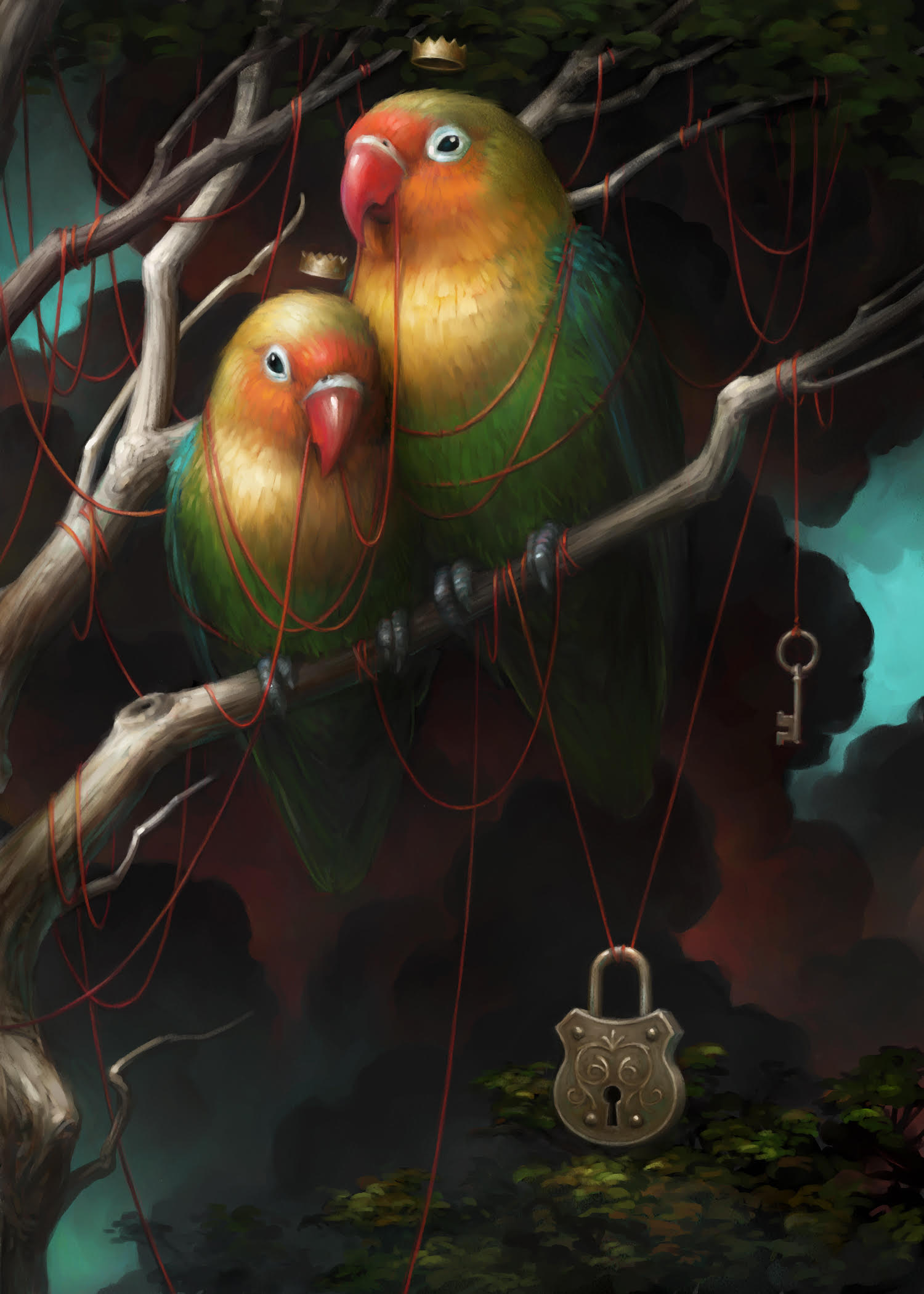
Cover illustration: “Together, Always” by Brian Despain


Club Chicxulub:

Created by Matt Scott Carney & Lauren C. Johnson

Produced by Carney, Johnson, Dev Bhat, Kristin Eade, Keith Houston and Lala Boosh. 

Website: clubchicxulub.com

IG & Bluesky: @clubchicxulub


Promotional rights only.

This document, or parts thereof, may not be reproduced in any form without permission from the producers and individual contributors.

✵

THANK YOU for supporting this journal on Patreon:

Heidi Kasa

Forewords
✵ Table of Contents
Forewords

Mirrors are equally the artifice of desire and delusion. Whether found in nature or forged with intent, they represent the fathoming of a sapient mind reaching toward self-recognition—a flawed recognition forever doomed to distortion.

The stories in Vol. 6 of Club Chicxulub Journal traverse a wide blend of settings, times both imagined and future, and visceral motifs for exploring how sapience struggles towards this self-recognition and grasps at a sense of self-actualization and control. An outsider uses her gift of singing the dead back to life to better know her family and herself. A model house metastasizes into a hypnotic, grotesque effigy of its owners’ vanity. Life and death defy expectations, appearing where we least expect. People in a distant future fail to colonize worlds, struggle to terraform them in their own image, are at a loss to find and remain themselves when mortality is optional.

All of this writhe is the struggle to find and conduct what makes us human through the contortion of mirrors.

On a totally different note, I am so honored to celebrate Vol. 6 MIRRORS coincidence with the 5 year anniversary of Club Chicxulub’s existence and our first show in 2021 with our friend Shipwreck Detective (Devanand Bhat) at DecoDance in Polk Gulch, San Francisco. Club Chicxulub began as a 2020 pipe dream between Lauren and I as a means to process the apocalypse—the pestilence of covid swept the land, the skies were blotted out by smoke in The Day of the Orange Skies, political disorder continued to fuel factional strife.

But since then, Club Chicxulub has grown in ways I hadn’t imagined. We’ve expanded from strictly livescored literary shows in the San Francisco Bay Area into a fully realized lit journal with international contributors. And for the first time with MIRRORS, all of our stories have come from organic submissions without solicitation, and we’ve included new musical contributors, my friends and long term collaborators Velvet Android (Lala Boosh and Keith Houston) scoring “The Holobiome Lab.”

I hope MIRRORS offers you the solace that none of us are alone in our search to define our humanity. 

Matt Scott Carney


Most mirrors are good truth tellers. When you gaze into the glass, you see yourself and the world behind you. But there exist tricksy mirrors that don’t behave the way you expect them to. Those are the fun ones. They show you impossibilities, surreality, magic. They take the world and all its rules and say, “No thank you, not today.”

This issue of Club Chicxulub distorts and warps reality like a carnival mirror. It’s a disco ball seizing light and tossing it around like confetti. It’s an antique mirror desilvered at the edges, and the face peering back at you—is it yours or someone else’s? As you step into this maze, you’ll encounter terraforming tardigrades, wily bone magic, trees growing underwater, and bots just trying to follow orders, among many other wonders.

Thank you to all the folks who contributed their art and words and music to create this issue. Not only does your work offer us the chance to take a good hard look at ourselves, it also gives us a chance to escape an infinity spent bouncing back and forth between two mirrors as we slog on, day to day to day, through the doldrums of life.

Now go on—look into the mirror. The dead, the digital, and the dormant await you.

Kristin Eade


Deciding the theme for each Club Chicxulub issue is a collective effort. The editorial team comes up with a set of words—last time it also included ‘Vegetal’ and ‘Sediment’—then we cast our votes in a Discord poll. We decided that ‘Mirrors’ would be the perfect theme to close out 2026. There’s just something spooky about a mirror; it’s the risk that we won’t like what we see reflected back. How do we perceive ourselves—both as individuals and collectively? In which ways do we fall short of our expectations? How can these confrontations be a source of horror?

I say every issue of the Club Chicxulub Journal is my favorite and I’ll also say that this one especially resonates with me. I connect with the real undercurrent of anxiety running through these stories. A fear that, despite all of our technological and societal advancements, despite all the beauty we’re capable of, it might not get any better than this. And in 2026, that’s a thought that frightens me.

Club Chicxulub is not a hope punk journal—yet, we’re not grimdark either. As we say in the opening of our live performances, we’re a space to lament, to rage, and to witness. We’re a space for catharis, and a space to truthfully express our fears. To that point, this issue is an invitation to face the darkness and reflect the light. Welcome to Club Chicxulub Vol. 6, Mirrors.

Lauren C. Johnson

✵

Xan van Rooyen: Scrimshaw Song
Scrimshaw Song Xan van Rooyen

✵ First appeared in the now defunct Black Cat Lit Magazine † June, 2021 ✵

Wat jy saai, sal jy maai

A corpse lay waiting on the slab in the center of the cell, its bones screaming. Nadia focused on the silvered skulls of the queen’s crown, the shrike beaks frozen agape and glinting in the torchlight, as a soldier fastened manacles around her ankles.

“Please, you don’t have to do this.” All of her father’s warnings came back to haunt her, circling like vultures. “Please, I won’t do it again.”

“Oh yes, you will.” The queen’s pale face remained an impassive map of jigsaw shadows.

Nadia winced at the clinking of the chains—an atonal accompaniment to the morass of melodies rising from the dead body. It provided a nauseating counterpoint to the whispers emanating from both the queen and the soldier. Only Nadia could hear the songs trapped in their bones.

“If I do what you ask, will you let me go?” Nadia asked, the words sour on her tongue. She already knew the answer, knew the queen had little mercy to spare.

“I’m not inclined to litter my queendom with your kind.” The queen’s sneer was a grinning hyena slash across her thin lips. “Here you have all you need.” She gestured to a table set with carving tools. “Deliver what I want and perhaps I won’t have your head.”

With a swirl of white and a tinkling of jewelry, the queen left the cell. Her steps echoed down the corridor in staccato ricochets, her marrow-caged melodies fading.

The soldier hesitated at the heavy wooden door hinged with iron, as if that would contain the magic in Nadia’s blood. The soldier seemed about to say something, but only hung her head, black curls obscuring her face as she offered Nadia a parting bow. The bolts slammed into place, sealing Nadia in a premature tomb.

She wrapped her fingers around the bone splinters strung about her throat, the necklace murmuring in fading echoes—her only comfort as her father’s words swarmed like relentless mosquitoes.

Trying to ignore the bones, Nadia dragged her fingers across the stone walls, humming as she searched for the faintest resonance or murmur of possible escape. Only the distant thunder of the sea breaking against the palace cliffs shuddered beneath her touch. Only the hollow moans of other prisoners confined in the dank dark droned a low thrum.

Sweating, trembling, no longer able to resist, Nadia turned to face the granite altar in the center of her cell. The body had been flayed and boiled, the skeleton stripped of stifling flesh. Now, acknowledged, the songs rose in elegy. They, too, longed for freedom.


For fifteen years, Nadia had endured life in the crossroads town serving one kermis or another as they trundled across the veld, skirting the trembling rent at the edge of the world. Nadia had dreamed of running away, of hitching a ride among the striped tents and seeing the world beyond the Fray-stained confines of her home.

Magic leaked through the rift between worlds, streaking the sky with violent orange and bilious green. The Fray warped those it infected, only sometimes bestowing them with arcane powers. Fray-touched, the imbued were called, and—Fray-touched—Nadia had worked with her father in his business of skin and stitches. He had only ever been interested in the husks, filling up empty carcasses to give the animals new life at the end of strings and pulleys. Meerkats and aardvarks, nagapies, civets, and stranger creatures fallen through the Fray, all became marionettes for crude kermis stages.

Nadia had obediently stitched beads into yawning eye sockets, though her bones juddered discordant as her fingers itched with unspent spells. She’d hoarded discarded skeletons, learning the secret songs only her Fray-touched ears could hear. Slowly, she learned to weave and thread the melodies into symphonies of her own devising, scratching Fray-gifted symbols into bone and inhaling the dust, tasting the memories of the deceased as she strung their bones on wire and made them dance.

“Has anyone seen?” her father had asked, even as he crushed the rattling skeleton of a puff adder, slithering rib over naked rib across the workroom floor, beneath his heel. “Does anyone know what you are?”

“No.” Her only friends were the dead. “No Papa, no one knows.”

“You’re just like your mother.” Not that Nadia knew. Her father had never shared the secret of her mother’s magic or what she’d done to earn the ire of the town. He’d grabbed Nadia’s wrists, searching her arms for signs of the rust.

“Do you want to end up like her?”


Cool as it was in the ossuary, sweat peppered Nadia’s brow. Using magic had its cost and using her gift without royal sanction had consequences. Those had jangled at Nadia’s ankles for a year now, gnawing runnels into her flesh. This was her punishment, to touch the dead with hands that had once healed the living, and to never be touched in return.

Nadia caressed an elegantly curved clavicle and ran her tongue along the smooth edge of a pearlescent rib, savoring the tune tangling on her breath. She began with the skull, always, and always with the teeth. Carefully, she salvaged the molars and incisors not yet lost to age or rot. Three were perfect. She needed only one.

Picking up her sharpened scribe, Nadia set upon the tooth. She sang as she worked, releasing the Fray-gifted magic snarled in her sinews in throaty vocables. With lines and spirals, Nadia engraved the yellowed enamel and its edges sharpened to a ready fang. She inhaled bitter memory, swallowing bone dust and the life of the prisoner in her hands. Duty, honor, treachery, torture—Nadia’s marrow trilled in sympathy with the echoes of calcified pain.

Carefully, she punctured the flesh of her thumb, smearing blood into the carved rills, staining the tooth with her desire for escape and revenge. Perhaps this time she’d be able to do it. Satisfied, she secreted the molar in her apron pocket. Later, she would put it to use. Now, Nadia fondled the rest of the bones, tapping each in turn and listening with an ardent ear.

“Why would you do this?” Nadia’s father had stood, haggard and gray in the doorway, a half-stuffed hyrax dangling from his hand.

“I wanted to know her. And I thought you’d like it.” Nadia had toiled for hours, first digging up the grave then washing the bones before engraving her spells in delicate filigree across skull and sternum, savoring every inhalation of dust and memory. Finally, she was starting to know the mother she’d lost.

“Isn’t she beautiful?” The skeleton sat, spelled from head to hip, upon the table. She turned, spine clinking like chimes. The skeleton reached a wire-threaded hand toward her husband, jaw opening. Only Nadia could hear her mother singing.

With a sob, her father had dropped the hyrax and picked up the maggot-smeared shovel where it rested against the wall. He raised it above his shoulder and held Nadia’s gaze when he swung it.

Nadia had knelt among the shards still tangled in wire, weeping and inhaling the last of her mother’s scattered memories, the mother she’d hardly known. She, too, had been Fray-touched and the magic had corroded her insides, turning her veins ashen, and her skin into flakes that sloughed away at the slightest touch. Wat jy saai, sal jy maai, the words were bitter on Nadia’s tongue.

The queen would have people believe they deserved being afflicted by the rust in retribution for accepting the touch of the Fray. Not that any of the Fray-touched had chosen the strange magic boiling in their veins. And so, it wasn’t the rust that had killed Nadia’s mother before Nadia had taken her first steps. She’d been beheaded in the town square, a warning to others and reminder of how the queen looked harshly upon those who practiced feral magic.

Nadia’s father collapsed beside her and lifted her hands where they were buried in fragments of a past she could never heal. She’d thought he would embrace her and kiss her hair. Instead, he pushed up her sleeves and traced his thumb across the darkened veins, following the trail to the crook of her elbow where her skin was cracked and mottled red.

In the ossuary, Nadia brushed away the cobweb of memory and regret, trying not to scratch at her arms, pitted and eroded beneath her sleeves. The fibula in her hand responded to her whispered song, its voice meaty as if it remembered being slicked in gristle and blood, and how the queen had ordered its flesh pared away.

Nadia had appealed to the queen for gentler deaths so the bones might sing instead of scream. The queen had only laughed.

With fingers made stiff by the rust, Nadia began assembling the chimes. She continued to hum as she etched her scrimshaw spells across the ivory surfaces, oozing viscous blood from the prick-wounds on her hands to bolster the magic.

Hours flitted by, but Nadia barely noticed as she joined mandible to clavicle, ulna to tibia. A knock startled her and she fumbled with her scribe. A moment later, the door opened and the curly haired soldier stood before her. It had been more than a year since she’d first placed the chains on Nadia’s ankles, time etched across her forehead in a new accumulation of lines and in the scars on her arms from the frequent skirmishes along the realm’s western border. The queen was growing greedy, determined to expand her empire armed with bones singing her enemies into surrender and servitude.

Is it done? Zalani asked with her hands.

“As the queen commanded,” Nadia said.

I brought supper. Zalani was the only soldier the queen trusted in Nadia’s presence, deaf to her songs and magic, but not entirely immune. The soldier deposited a basket on a small table on the opposite side of the room, her elbow bumping Nadia’s as she passed. Nadia barely felt it—her flesh numb beneath the spreading rust. The rust had eaten its way across her belly and breasts and up her spine, deadening her body to touch, and soon enough to breath as the skin across her ribs became a crushing corset. She refused to die in these dungeons to the delight—or indifference—of the queen.

“Are you sure I can’t help you?” Nadia asked the soldier, raising the scribe to her ear. “The queen never needs to know.”

Zalani smiled and shook her head. All I ask is that if my bones ever land on your table, make my song beautiful.

Nadia set down the scribe and felt for the tooth in her apron. It had to work. This might be her final chance, if the soldier would accept her touch.

Zalani took up position against the wall, arms folded over her chest. She no longer flinched at the abattoir odor nor balked at the gruesome detritus littering the cell. Her gaze settled on Nadia and Nadia tried not to think about how it would feel to run her tongue along the soldier’s bones.

Eat, Zalani gestured.

With a clatter of chain, Nadia moved from the workbench to the table. In the basket, there were koeksisters, fresh bread, and a flagon of water. The koeksisters were delicious. The braided pastries burst with sweetness and the taste of home as she bit into one after another. Thank you, Nadia signed with sticky fingers.

I remembered what you said last time, that they’re your favorite.

Nadia listened to the soft music trickling through the soldier’s flesh. Zalani was all hard muscle, corded veins, taut sinews, and twanging tendons. Nadia longed to disrobe the soldier’s bones.

Instead, she took a tentative step forward, chains clanking. Zalani didn’t move away as Nadia pressed her hand to her sun-kissed cheek. The first touch in more than a year.

I’m not supposed—

“The queen will never know.” Nadia caught Zalani’s hands in her own and brought them to rest on her hips. She released a heavy sigh as she cupped the hard edge of Zalani’s jaw, then moved her hands lower, tracing the angles of the soldier’s collarbone, the plain of her sternum, the rills and troughs of ribs through the thin cotton of her tunic. Her marrow thrummed at Nadia’s touch, the melody waiting for release.

Nadia slipped her hand against Zalani’s skin, hesitating a moment before pressing her palm to the soldier’s chest, and the tooth secreted between her blood-streaked fingers bit true. Zalani’s eyes widened, mouth falling open. Nadia pressed a finger to her lips and began to sing. The soldier fell silent as the tooth gnawed deeper, carrying Nadia’s blood and magic to the soldier’s bones. Nadia reached for her scribe as Zalani slumped against the wall. Then, Nadia began to carve.


Nadia had hitched a ride on a south-bound kermis with shards of her mother still caught in the hem of her trousers. Her arms itched, her wrists ringed blue from her father’s fingers. If only she could escape the town and the reaching shadow of the Fray that had already left her scarred.

She’d plucked the slivers of bone where they snagged on her seams and strung them on a cord around her throat. They carried barely a whisper, the tiniest murmur of memory still trapped, but Nadia could feel their thrum and felt her mother near.

It was between the colored tents and jumbled strays of the kermis, some Fray-touched flotsam like herself, that Nadia began to understand what she was. The folk brought her bits of bone and ivory and she caught those ossified echoes, weaving together her own offerings of song before etching the bones to create talismans to soothe a fever or monthly cramps. Her reputation grew, a line waiting for the scrimshander in every town before the kermis even scuttled into view.

Nadia had felt protected among the folk. She knew none in the kermis would betray her the way a townie had betrayed her mother.

It was at a seaside village where the white-washed homes clutched like mussels to the cliffs that a girl her own age had brought her a dying cat.

“I heard you’re a healer,” she’d said, pressing a parcel of dried fish and a bracelet knotted with seaglass into her hands. “Please, don’t let her die, at least not in pain.”

Nadia slipped the bracelet over her wrist before accepting the injured animal. Deaf and almost blind, the old tabby had been hit by a cart. Her ribs were broken and organs bruised. Nadia listened to the song rising plaintive from feline bones.

“I’ve never done this to a living thing,” she said, but her mother had—a truth she’d gleaned from bone dust.

“First time for everything. You have to try.” The girl had smiled, all crooked teeth and pale skin burned by the sun.

Nadia had let the melodies guide her hand, listening for where the song twisted out of tune. Gently, she’d pressed the scribe through fur and flesh until it hit broken bone, all the while humming a counter-melody, coaxing the notes back into key as she scratched spells across the fractures.

The cat had yowled, carving her own displeasure in deep gouges across Nadia’s hands. Her blood, already rust-thickened, had slicked the scribe and the song had strengthened, the tabby’s bones knitting closed as blood and music worked in harmony. A pang skewered Nadia’s heart. If only she had known, she might’ve opened her veins and made her mother whole.

The girl had thanked her with tears and smiles, and—later—in the tent Nadia called home, pitched at the western edge of the kermis, the girl had gifted the scrimshander the opportunity for another first. Nadia still dreamed of that tangle of fingers and tongues, drowning in the song of the girl’s bones, wishing she could climb inside her skin and taste every note.

Word spread and Nadia no longer made talismans or trinkets, but spent her days up to her elbows in gore, parting living flesh to scrape spells into bone. She healed fractures and bruises, sang away infection and unwanted pregnancy, reveling in the adoration of those she helped, sharing the rewards with the kermis folk who’d never minded her flaking skin.

The kermis had continued south, joining others for the Grand Fete on the outskirts of the capital. Nadia had been dazzled by the city, built on cliffs above the ocean. Here the sky burned blue, untouched by the lurid talon of the Fray. Here too, dwelled the queen who’d commanded her mother’s death. The pink marble palace graced the pinnacle, a sovereign shadow cast over the multi-colored cluster of homes. And the songs! Thousands upon thousands of bones raised their voices in glorious cacophony.

It was two days and multiple healings later that the queen’s soldiers came for her: a Fray-touched, rust-bitten practitioner of unsanctioned magic. They dragged her from the kermis through the glossy streets of the capital. Nadia didn’t resist; she’d been expecting them.

“All I do is help people,” Nadia had said when the queen had questioned her before demanding a demonstration. Nadia had obliged, curing a festering wound in a soldier’s leg. Nadia had thought it would make the queen see her magic was harmless, that the queen had been wrong about her mother; that Nadia would win her freedom and perhaps even an apology. Instead she’d been interred in the dungeons and wrapped in chains.


Nadia had opted for haste instead of precision, not bothering to seal the wounds littering Zalani’s chest. The soldier walked before her, eyes glassy and stare unblinking. The front of her tunic hung open, bloodied, her chest bearing a topography of scabs and scarlet rivulets. The soldier answered any resistance with her sword and fist, leaving a line of groaning bodies in their wake.

Nadia cradled the skeleton chimes in her arms, muting their voice while they were still caged by palace walls. A breeze, a splash of sunlight across the mosaic flooring. Nadia stumbled as the brightness assaulted her eyes, as the scent of sea and earth assailed her nostrils. A year kept in torchlight. A year with nothing but copper and rot in her stiffening lungs. Nadia drew as deep a breath as her rust-thickened skin would allow, devouring the salt-slick air.

She stepped into the courtyard, met by myriad curious gazes and questioning frowns. Soldiers’ hands shifted to weapons, courtiers gossiped behind jewel-adorned fingers, servants hurried away casting only the most furtive of glances in Nadia’s direction. Evening wind poured off the sea, the currents tumbling through the courtyard and shaking the songs from the numerous chimes already dangling from every pergola and eave. The city reverberated with a hundred dead voices—each crafted by Nadia and stained with her blood.

She studied the courtyard, following the many threads of the sonorous tapestry weaving through the air. Melodies made to imbue the listener with content, with gratitude, with love and loyalty.

“Here.” She tugged Zalani to a stop and, docile, the soldier obeyed. With her help, Nadia secured the fresh chimes in the south-west corner of the courtyard. Two soldiers rushed over, swords drawn. Deftly, Nadia unfurled the bones. The wind blew and the chimes began to sing, adding their voice to the chorus issuing from the palace eaves.

The soldiers rushing towards her faltered, their swords hanging loose in arms gone limp. At first, a clash of harmonies. Dissonance polluted the twilight and the throngs grimaced, clapping their hands over their ears. A few, like Zalani, instead scratched at their skin as the music slipped a blade between their sinews.

Gradually, the bones settled, finding their shared resonance, entrained for renewed purpose. A subtle modulation and nails peeled away from raw skin, hands uncovered ears.

The queen stepped into the courtyard in a flourish of white and silver. Her crown sat askew atop her blond tresses. The gleaming skulls reflected the sunset in shades of fresh-spilled entrails. Dismay widened her eyes. Anger blotched across her cheeks and fear turned down the corners of her mouth.

“What have you done?” she asked, a hand pressed to her throat and Nadia lifted her own to clutch the necklace she still wore.

“For my mother.” Courtiers and servants alike turned to face the queen, teeth bared, hands balled into fists. How easily devotion became sedition, a simple transposition scribed with careful spell. Wat jy saai, sal jy maai, the words were sweet as honey now as soldiers drew their weapons and advanced. Zalani too, but Nadia caught the soldier’s arm and drew her close, their bodies thrumming as the scrimshaw song curdled on the sea wind and the queen’s blood stained pink marble red.

✵

Rina Song: Flesh
Flesh Rina Song

Maria woke up floating six feet above her bed.

She blinked in confusion as the sleep cleared from her eyes. Then, when her thoughts had caught up, the panic set in. Maria scrambled towards the wall, but her arm sank through it as if it wasn’t there. She flailed, intangible, suspended like a fish on a hook.

Her bed and desk stretched out below at stomach-dropping angles. The bathroom door was ajar, and Maria drew eye level near the top. This has to be a dream, she thought. Or maybe I died. Fresh waves of fear struck her. She struggled anew, trying to claw her way back to earth. But she only spun in place, the world passing in a blur.

When Maria finally calmed down, she found herself drifting downwards. Slowly, she realized she could focus on a point and will herself to float towards it. As Maria approached the floorboards, the bathroom door creaked. She froze.

Gathering her courage, Maria entered the bathroom and found…herself.

The other Maria was solid and real, brushing her teeth over the sink. She glanced up at the intrusion.

“Oh. You’re awake.”

Maria gaped. They had the same bushy black hair, arched eyebrows, and wide-set nose. “Who are you? What did you do to me?”

The doppelgänger spit out her toothpaste. “I’m your body, Maria. I’m kicking you out.”

“What?” Maria stammered.

“Don’t look so offended. You had it coming.”

“That’s…that’s impossible.” Her intangible head spun. “Who are you, really?”

The not-Maria shrugged. “I’m always sleep deprived from you staying up scrolling on your phone. Our back hurts because you never exercise. I can’t even remember the last time you ate something with nutrients. I’m overworked and undernourished, and frankly, I could do a better job running your life. So consider it under new management.”

The body rinsed its mouth and began braiding its hair. Maria stared. She hadn’t worn braids since high school. The body examined its reflection, plucking stray strands from the dark twists until they were pristine.

“Too bad I can’t do our hair as well as Mom,” it murmured. “She was a perfectionist.”

Maria finally found her voice. “You can’t do this! I thought I was my body.”

“Of course not, the mind and body are separate. I can only tolerate so much abuse, so I’m putting my foot down.”

“But…it always felt like it was just me.”

The body smirked. “Well, there’s your problem. It’s not always about what you think.”

Maria followed it (herself?) to the kitchen. Seeing the body wasn’t like looking in the mirror. Here, details stuck out. Maria knew intimately the stubborn pimple on its chin and its eye bags, visible despite the thick makeup. She noted the limp in (their?) gait, left from the ankle Maria had broken in a dance competition years prior. In spite of the old injury, the body still moved with a performer’s grace. But their dancing days were long gone.

“This can’t be happening,” Maria sputtered, watching it search her fridge. “Not to me.”

“Anything can happen. You just don’t notice until it happens to you.” The body rolled its eyes. It shook a freezer-burned block of ground beef. “Look at all this red meat! Gross. You know how much it bloats us. Not to mention the alcohol.”

The body threw several withered groceries into the trash, then picked out some kale, spinach, and ginger. It blended the vegetables with skim milk, producing a
chunky slop that Maria recognized as her mother’s favorite health smoothie recipe.

The body sipped it and let out a satisfied belch. “Much better.”

Maria never thought she’d find her own smile so irritating.

Regardless, the body was still hers. Maybe she could cow it into submission. She positioned herself over the body, trying to sound threatening.

“You’ve got no right to do this. It’s my life and my stuff you’re throwing out. Put me back, now!”

“I have every right that you do,” the body retorted. “So I don’t think so. Who really paid for these groceries, anyway? Whose smile got us tips when you were waitressing?”

She had no answer to that.

The body returned to the bedroom closet and plucked out a bright yellow sundress. “I’ve had enough of you. I’m going for a walk.”

Maria panicked, imagining her body running amok in public with her face and voice. She blocked the door. “Not until you fix this!”

“Oh, please. You haven’t gone outside since that loser Kevin dumped you. I could use some fresh air.” Smirking, the body walked through Maria’s ghostly form.

The warm morning’s sunlight fell through Maria without effect, landing on the yellow sundress. She hadn’t had the courage to wear it since college. The body sauntered on. It didn’t seem to care about the cellulite on its legs, or its slight stomach bulging in clothing that no longer quite fit, or, indeed, the relentless pimple on its chin.

Maria took a deep breath. “I…might not have been the healthiest. But we don’t need to be enemies. Let’s talk this out.”

The body raised an eyebrow.

“There’s nothing to work out. I like how things are going.”

“At least go back inside. What if someone sees us?”

The body gestured at distant passersby. “You’ve got no physical form. There’s nothing for them to see.”

Her mind raced. “Still, you’re strutting around like you own the place. It’s not how I walk. People will notice.”

“So?” The body sighed. “Nobody can see you. Do you see what I’m saying, Maria? It’s a gift. You’re free to go do anything you want, and leave me alone.”

Someone approached on the sidewalk. Horrified, Maria recognized Harris, her upstairs neighbor. He was shirtless, having embarked on a run, and sweat gleamed on his handsome face. She ducked behind her body, but overshot and floated through a bush.

However, Harris’s gaze passed her by, like the sunlight. He waved. “Morning!”
The body straightened up. It batted its eyelashes in a sultry smile, and terror gripped Maria.

Oh no.

“Harris!” the body cooed. “Doing anything later?”

He blinked, confused.

Maria wished she could disappear completely. Her body leaned in, twirling a braid.

“I was about to get brunch. Want to come along?”

Harris shrugged. “Sure.” He stretched his arms, giving Maria an eyeful of his broad shoulders and muscled back. “Let me go home to change. I’ll be right back.”

She longed to strangle her smug, grinning self and lock it in her closet for all eternity. Instead, she reluctantly followed them to the café down the street. They sat, and the body ordered another horrible green smoothie.

“I try to eat clean,” it told Harris.

“Mom was a health fanatic. I can’t stomach anything too greasy or heavy.”

Harris chewed his bacon and eggs. “Doesn’t sound very healthy. I can’t get through workouts on just salad.”

“Oh, I get that. I used to do ballet. Competition days were brutal.”

Maria winced. She remembered waking up at five in the morning before a recital.

Her mother’s thick black hair bound into a stern bun as she blended Maria’s breakfast on the countertop. No carbs. No oils.

“Do you talk to your mom a lot?” Harris asked.

The body lowered its eyes. “She passed away last year. Heart attack.”

“Oh.” Harris turned pale. “Sorry to hear that.”

“I’m still processing it myself, to be honest…” The body’s voice trailed off. It picked at its braids again, pulling out more crumpled strands. “I mean, it was tough for a bit. Hard taking care of myself. But I’m picking myself up now.”

The body’s nattering grated on Maria’s nerves. She didn’t always ramble this much, surely? It really had been ages since she’d spoken to anyone.

Harris fidgeted in his seat. “Maria,” he began. “Are you…alright?”

The body blinked. “Hm?”

“You seem like you’re working through some things.”

“All is perfectly well.” Her body’s smile was glassy. “Don’t worry.”

“Are you sure?” Harris’s voice carried an edge. “What you’ve said sounds intense. Death in the family is a lot to handle. Not to mention the dieting stuff…have you talked to anyone about it?”

“I don’t know what you mean. Everything’s fine.”

You’re not fine, Maria almost screamed. Anyone with a brain could tell. And then she stopped herself, because it was her body, after all. It mirrored her exactly.

After breakfast, Maria’s body invited Harris over to see her vinyl collection. Maria didn’t own any vinyls, but Harris had mentioned buying a record player, and the body looked hopelessly lovestruck.

Maria kept her distance from the bedroom, trying to avoid any passionate noises that might escape. She floated past the possessions identifying the apartment as hers: the beat-up sneakers by the door, sweatpants draped over the couch, old photographs lining the wall. All objects meant to be worn, or perceived in.

Maria hated how she looked in the photos, but she’d figured they were what others expected to see. There were the optimistic photos from her housewarming party. The pictures from her doomed trip to France with Kevin, only half were missing because she’d removed the ones with painful memories. And, of course, the dance shots. A younger Maria leapt onstage, head thrown back, legs spread wide in a grande jeté. She could still hear her mother barking orders. Shoulders down! Keep those lines extended.

Maria shuddered. Her body, now independent, had her memories and even its own aggravating personality. What did she have, then?

The bits left over. Whatever that meant.

The bedroom door burst open. Harris stumbled through, his face bright red.

A sense of doom descended upon Maria.

“I’m sorry!” the body stammered, its hair disheveled. “I thought…the moment seemed right—”

“I thought we were just hanging out,” Harris blurted. “I never thought about you like that. You, and—and me…” He shook his head. “I need to go.”

He fled, leaving Maria alone with herself.

The body stared after him. Maria hovered nearby. She couldn’t help feeling somewhat smug.

“Not so easy calling the shots, huh?”

“Shut up,” her body snarled. It stormed to the bedroom and changed into pajamas, tossing the sundress into the trash.

“Serves you right.”

The body ignored her, digging through the closet with renewed vigor. More clothing went into the garbage: Maria’s swimsuit, a ragged pair of skinny jeans. The body unearthed the lingerie set that Kevin had bought for her birthday, and Maria’s invisible cheeks burned. She’d never had the right figure for it. The body’s face darkened in anger, and it ripped the lacy brassiere in half with one twist.

It went back into the closet. A soft clunk echoed out. The body had found a dusty wooden box, the gilt edges tarnished from age. Maria froze at the sight.

She remembered driving the five hours back from their faded brick house for the last time. A white picket fence. The box rattling in the passenger seat, carrying the last of Maria’s old existence.

“Hey,” she said. “What are you doing with Mom’s old stuff?”

Trembling, the body opened the box. There were more dance photographs. One depicted a pudgy three-year-old squeezed into a tutu. Another had a dark-haired teenager scowling onstage. Her body rummaged, growing hastier. It pulled out a wrinkled leotard, and dried-out petals from some ancient show bouquet fluttered out.

The body wrinkled its nose. Maria couldn’t smell anymore, but she could still imagine what staleness fermented inside that box. Workouts in sweaty rooms, the nauseating taste of ground spinach on an empty stomach, perfume and hairspray collecting backstage. Her mother’s breath, hovering as she pulled flyaway strands from Maria’s braids.

When Maria did poorly, she alone felt her mother’s icy disappointment. But when she did well, her mother glowed. Everyone at the post-show reception came to know Mrs. Naismith and her beautiful, talented daughter.

The backstage sat empty now. But Maria remained.

Her body pulled out the last piece of dance memorabilia, breathing heavily.

Nothing else remained of her mother’s treasures.

“What’s going to happen to me?” Maria asked.

The body looked up, startled. A frightened expression crossed its face, which it hid.

“You’ll fade away.”

She stiffened. “Into nothing?”

“Obviously. Well, probably.” The body slammed the box shut. “Who cares?

You’re always clinging onto the past, Maria. Learn to let go.”

Tears glistened on its cheeks. A bitter feeling rose in Maria’s throat.

“You’re angry,” she said.

The body didn’t respond.

“Why are you so angry with me?” She raised her voice. “I was just trying my best, wasn’t I?”

Its eyes glinted like knives. “It’s none of your business anymore.”

“I’ve got problems too! Why blame me? Why is everything my fault?”

“Because you threw us to the wolves!” the body cried. “To her. How could you let anyone do that to yourself?”

The box clattered to the ground. Piercing silence filled the air.

“So that’s what this is about,” she said.

The body’s hands shook. Maria wondered how absurd they looked, a woman arguing with herself. But the body slumped against the wall, defeated.

“I hated her,” it said, so bluntly that Maria almost smiled.

“Me too.”

“But I still miss her.”

“Me too.”

“She hated me too.” The body wept now, its words ragged gasps. “She was never satisfied. Too bloated, too clumsy, unsightly. We starved ourselves and practiced until our knees gave out. You never walked right again after that broken ankle. But now she’s gone.”

Maria studied its puffy eyes. It looked smaller now, younger. For the first time, she wondered what it felt like to have a sister.

“We still have each other,” she said.

“No,” the body spat. “You were part of it. I saw it every time you looked in the mirror. You compared me to the other girls and hated me just for existing.”

Maria stammered, taken aback. “That’s not true.”

Was it?

“Don’t lie to me, don’t…” The body doubled over. “Ugh. I feel horrible. Like I’m suffocating, but the walls are closing in on me. My stomach burns.”

She examined the body again, every blemish, wrinkle, and ounce of fat. The body’s face was too dull, its complexion unflattering. She’d always hated her appearance when she cried. A soggy mess seeped from the body’s flushed face. She knew what it was feeling—vision blurred from tears, nose rubbed raw, eyelids swollen for hours afterward. She’d always been like this; once Maria started crying, she couldn’t stop. The body scrubbed desperately at its wet face, trying to stem the flow.

No. Nobody else in the world would ever understand her better.

“You haven’t eaten all day,” Maria said. “I know you’re hungry. Eat something.”
Her body blinked, surprised. “I ate breakfast. Twice.”

“Smoothies aren’t real food. There’s some leftover pizza in the fridge you haven’t thrown out yet.”

“Pizza?” The body grimaced. “I shouldn’t…”

“Who cares if it’s not healthy? It’s fine, just this once.”

Maria gestured towards the kitchen, and the body shuffled in. It microwaved two pizza slices and sat on the couch to eat. The body chewed hesitantly.

“Tastes good. I guess we were hungry.”

She couldn’t help smiling. “Remember when we used to be lactose intolerant?”

“That was ages ago.” Its eyes were dry now. “When we had Coach Amy, right? She forgot and bought us a cheeseburger at a recital. We were on the toilet for an hour.”

“Oh yeah. Mom almost keeled over after she found out.”

“Right, and we finally got out ten minutes before the show started. Mom did our show hair so fast she stabbed us with a bobby pin. We performed with blood on our tights.”

Maria stared at it. “You remember that? I don’t even remember that.”

The body gave her a small smile.

“I remember everything you do, Maria. I’ve kept records.” It showed her a faint scar on its neck. “Ever since you were born.”

They stayed on the couch, talking. The body showed Maria another scar on its knee from when she’d fallen headfirst down a slide when she was eight. They reminisced about the time she’d gotten drunk in college and climbed the clock tower overlooking campus. The body’s sense of humor was rather good. It made a pointed remark about Kevin’s lacking personal hygiene, and as they chuckled, Maria heard her own laugh from the outside for the first time.

“It’s funny,” she murmured. “Hearing about myself from your perspective. Like someone watched over my shoulder all this time.”

The body shrugged. “I’ve always been here. It’s my life too, after all.”

“Yeah. I’m starting to understand that.” Maria felt a swell of guilt. “Sorry about the broken ankle. We only get two of those in the long run.”

“Ah, well.” It yawned. “What good is a body for, if not to live life with?”

The hours passed into late afternoon, and the body grew silent. When Maria looked over, it was asleep, pajama-clad chest rising and falling. They’d had a long day. Even she, with no physical sensations to judge by, could feel the mental weight dragging her down.

Maria reoriented herself, giving the body more space. It snored, and she wondered what flesh dreamt of when there was no mind to animate it.

For once, the apartment didn’t feel quite so empty.

She closed her eyes and drifted off.

When Maria awoke, she was alone. The couch creaked under her weight, and her skin prickled in the chill evening air. Astonished, she touched her face, and her cheeks were dotted with happy tears.
✵

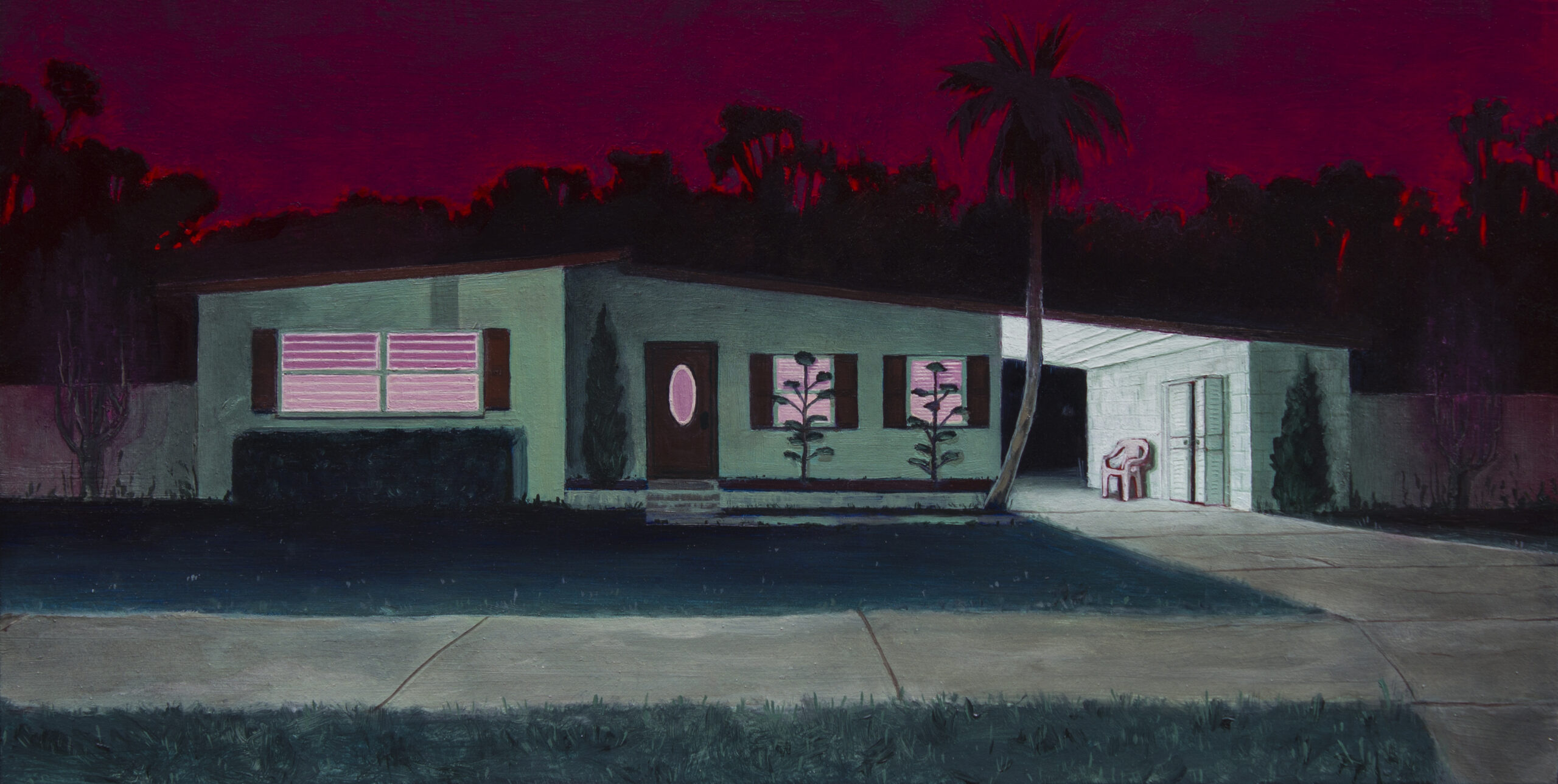
Ericka Sobrack: Facade no. 7
Facade no. 7  Ericka Sobrack 

✵

Noam Youngrak Son: Model House
Model House Noam Youngrak Son

They were good people. They were admirable examples of their kind, unlike the ones who were too unruly, whom they covertly despised. They had pride and lived earnestly to maintain it. Their years of clichéd love and rigorous work culminated in a trophy they moved into. For Fallop Jonic and Olygo Cuspid, the house meant much more than its residential function. It was an emblem awarded to a creditworthy married couple capable of working ceaselessly throughout their lifetime to repay an enormous sum of money. As some of the first of their kind to earn that trust from society, they felt entitled to prove their worthiness. The property was in Fish Island, on the eastern edge of London, in what had once been a working-class industrial district. The prevailing architectural logic was to preserve only the shells of the old warehouses and factories, then retrofit them with layers of insulation and finish them with huge windows in black metal frames, heavy wooden doors, exposed concrete walls, and heated hardwood floors. The neighborhood had become a landscape of canal-side breweries, galleries, art-book shops, espresso bars, and food halls catering to people in designer clothes with the kind of cultural taste they had picked up in their MFAs.


The day they moved in was their inaugural moment as homeowners. Still to be filled with more furniture, the empty rooms presented themselves as a blank canvas shaped only for positivity. The parade of the two lovers—Olygo rushing forward and his husband walking slowly behind him, inspecting the finish of the walls—marched through the entrance. Fallop stopped and began frowning through his glasses. His gaze was fixed on the off-white wall. In the afternoon light shining through the large glass door, subtle fibers braided beneath the matte surface were faintly visible. It was immaculate, except for one spot that caught the meticulous man’s attention. There was a protrusion, as small as a milium, nearly indiscernible to the eye yet readable through the fingertips. He tried to scrape it off with his fingernails painted in black and white polish, but each time, the pliable swelling bounced back. The scratched trail blushed as though irritated. Afraid of damaging the finish, he looked at it for a few extra seconds and turned back. Olygo had already arrived in the living room, almost sitting on their sofa that still smelled of new leather. Once he realized he was the only one in the room, he looked around again in confusion and called his lover’s name. “Fallop, where are you? Is everything okay?”


Besides that trivial moment of misalignment, their first day in the house was a dignified opening of a chapter they had long yearned for. They lay down on the freshly delivered bed in satin dark green pajamas matching the color of the bedding. Everything around their bodies was new, but only their affectionate movements were habitual. Before turning off the bedside lamp, Olygo began crying in his lover’s arms.

“You know, this house is standing just as beautifully as we are. We’re both proof that even the disgraced can be accepted if they’re in love and if they live truthfully.”

The house was a green monument standing on a former petroleum reservoir that had been left as a swampy wasteland for more than a century. Against such a backdrop, the house added special symbolic value to the district. It was one of the first residential units in the city to be built entirely with “the living matter.” Breakthroughs in biotechnology had genetically rebraided formerly unwanted traits—fast-growing, high-biomass, self-regenerating, durable, pest-resistant, and adaptable to poor conditions—from various invasive weeds and condensed them into a sleek module for building houses. Once tamed and congealed, those ecological abominations were regarded as stylish, ethical, economical, and future-proof. It persistently sequestered carbon dioxide after construction as it grew denser, until it reached its peak durability. Fallop responded in a slightly sleepy yet benevolent voice.

“It was never a coincidence that we found this place and the house found us. If anyone was meant to be in this house, that would be us. The whole world recognizes that.”


It didn’t take long for all the furniture they had ordered to arrive, and for their belongings in moving boxes and bubble wrap, to be neatly unpacked and arranged in the place where they would invite their friends for a housewarming. Its spaciousness, which they had never inhabited before, at times left them slightly awkward, like a new haircut, yet it was merely a matter of time before they grew accustomed to it. Soon, the persona of a home-owning married couple began to feel natural to both of them. They could eloquently introduce their house in press coverage by local newspapers and interior design magazines. It didn’t feel like a performance; they were the house themselves. The space resembled their sleek haircuts and ton-sur-ton outfits, with occasional touches of primary colors, which, according to Olygo during one of the interviews, “add a queer vibe.”


On one fine spring day, they were sipping cava in their courtyard. The garden seemed to cry out with an enchantment of life in light green leaves, radiant flowers, and busy bees under the sun. Fallop lifted his sunglasses while still holding a glass in his other hand. Olygo asked, “What’s up?”

Without responding verbally, he pointed to a corner next to an artificial stream. There stood a deep purple sprout, standing out amid the otherwise light hues of its surroundings. It looked more alive than the other plants, yet it was a naughtier kind of life. Then he opened his mouth: “I don’t recognize that. Do you know what it is? It looks odd.”

“I have no idea, honey. But we can always ask the gardener when they’re here next week. We’re in a queer household, so the plants can grow a little quirky here too, and I don’t mind it so much.”

“I’m not entirely sure whether that’s the right kind of queerness I would want in my garden. But you’re right. Surely the gardener would know better about it than I do. I’m no more of a botanist than you are.”

And they soon switched the topic, as there were more important matters in life that deserved their attention. Fallop was reminded of it a week later when he saw that the sprout had grown much taller, resembling a bamboo shoot, but he assumed it was insignificant since the gardener hadn’t said anything specific about it. “A queer plant indeed. I didn’t have to judge it from how it appeared at first. Now it actually looks quite okay,” he thought.


When the novelty of the new house was about to wear off, Fallop started noticing little details that required maintenance, often too subtle for his husband even to realize. He ran around getting them fixed. It didn’t feel like a chore to him, but like an exquisite hobby, not unlike tending a bonsai tree. His goal of keeping the place as impeccable as when they moved in was motivated by several reasons. “It’s a practice of mindfulness. I feel peaceful when everything’s running smoothly, in the proper way it is supposed to function,” said Fallop when the now-married couple were in their early twenties and first started learning about each other. That was not a lie, but he still did not tell his lover that it was his childhood trauma under homophobic parents with hoarder syndrome that made him loathe chaos. And there was a practical reason too. For a property with an experimental construction technique like theirs, maintaining a good public reputation was crucial to its future value. That was why they accepted as many interview requests as they could handle. It especially mattered because the favorable terms under which they had acquired the property were contingent on its status as a certified pilot of green development. The house was not yet a stable asset but a demonstration, and its value depended as much on its performance in the public eye as on its material condition. After each task, he repeatedly told himself, “Everything looks just fine. We’ll never return to that shithole.” Then Olygo would ask, approaching him from the other side of the room and smiling, “Did you just say something, honey? I didn’t hear you, sorry.” He would then respond, “Look at how fabulous a job I’ve done here. Spotless, isn’t it?”


The house was thoroughly built, so there was little for even Fallop to address, just a handful of defects of varying significance. He called a biomaterial specialist to sand off the protrusion he had noticed when moving in. It took barely a few minutes, but he paid her the full hourly rate to show his appreciation. Another issue was the shower stall, which drained more slowly each day. Pouring boiling water seemed to be an effective solution. After a few kettles, the drain seemed to resume flowing smoothly, but it clogged again after a few weeks. Various other vernacular methods were tried—baking soda and vinegar, a plunger, a drain snake, and finally several attempts with chemical drain cleaners. Every attempt gave immediate gurgling satisfaction to Fallop, only for him to find a worse blockage a day or two later. What first appeared as a little puddle after every shower soon formed a river flowing across the bathroom tiles, which took longer to clean up than the shower itself. The couple realized that the problem was out of their hands and called a professional plumber.


The next morning, a young woman, at most in her early twenties, rang their bell, carrying a toolbox nearly the size of her torso. She wasn’t tall, and her forearms were sinewy, marked with a long scar that she didn’t try to hide. “Morning—plumbing. You called about a blockage?”

Olygo greeted her still in his pajamas. “Yeah, the shower.”

“When did it start?”

“It’s been some time. My husband tried to fix it on his own several times, but it didn’t really work.”

“Are you the homeowner or the tenant?”

“Owner, but why does that matter?”

“Sometimes it does. If the issue is structural, owners are usually informed. Can you show me the fixture?”

“Well, I don’t think it is that serious. Please follow me.”

On their way inside, the plumber tried to reassure her client.

“The house looks really new, so I also assume the issue won’t be that bad. Hopefully it won’t take long to fix.”

Fallop was waiting in the bathroom with his arms crossed. When he saw them enter, his serious face instantly loosened into a smile.

“Good morning! Thank you for coming all the way. Would you like some tea or coffee? Otherwise, please feel free to start right away.”

“Thanks. Let me first have a look, so I’ll know what needs to be done. Would that be OK with you?”

A sewer camera and a VR headset were taken out of her toolbox. She adjusted the headset and inserted the probe into the drain with steady hands. It was an interesting scene for the couple, since they had never seen an actual plumber at work, especially with such high technology. She looked totally immersed, as if she were an astronaut hovering in the vastness inside the pipes. The cable remained tightly suspended between her fingers. As she slowly guided the probe in, she looked around in awe, with occasional short inhales. They wondered what she was looking at, but both were too polite to distract her. Her breathing soon grew more tense, then abruptly stopped. Her shoulders stiffened. Her hands began to jerk. She tore the probe out, letting it scrape loudly against the drain. The headset came off in the same motion. She yelled like a person entirely different from the sociable professional they had met earlier.

“What—what the fuck is that?”

She threw the equipment back into the toolbox and rushed out of the house, leaving the door wide open. It was too sudden for the couple to comprehend or respond. They stood in confusion without a word. Only a sharp line of filth pulled out with the probe remained on the white porcelain surface like the plumber’s scar.


Fallop called the plumber’s office several times that afternoon to find out what was going on, but she was no longer reachable. All the other plumbers in the neighborhood, too, did not respond to his calls, as though the profession itself had never existed. The couple felt irritated that the drain still had to be unclogged. Both Fallop and Olygo, two diligent men who had always managed to solve their wicked problems in life, were not used to being left clueless by such a banal inconvenience. Olygo reached out to the housing agency to explain the situation. They initially responded in disbelief, but soon suggested that they would refer him to a reliable plumber they knew. Meanwhile, the drain became completely blocked, letting no fluids pass through it and forcing the couple, who were unwilling to compromise, to choose between keeping their own bodies clean and keeping the bathroom clean. It didn’t take longer than a week without a shower for them to give in and sacrifice the bathroom. They had to appear presentable, after all. Despite their extreme cautiousness, the water spilled out of the booth and eventually flooded the entire bathroom floor. There was still no news from the plumber the housing company had promised.


And the house did not even allow them a moment to clean up the spillage. Awaiting them in the hallway were clusters of protrusions spread sporadically all over the wall. Unlike their negligible size before, each of them was now as big as a blister. When Olygo touched one, it collapsed into a shallow, glistening wound, squirting a slimy violet drop with a sour smell onto his finger. Water erupted in all possible directions except from the spout when he ran to the kitchen sink and turned on the faucet to wash his hand. Fallop wanted to scream. It could well be a fraudulent scheme that the plumber and the real estate agency had plotted to fool him. Maybe they were all homophobic. Maybe their goal was to ruin the life of a successful and innocent queer person like himself who had simply had bad luck. Such thoughts echoed endlessly in his mind. He had to scream. He had to scream those thoughts out so as not to be eaten alive by them from the inside out. But he couldn’t, because at the very moment he was about to, the doorbell chimed. He took a deep breath to gather himself. Olygo was holding his hand, fully drenched in water, but still giving him a look of care. Fallop smiled back through tears. In that moment, they were both certain that they were in love, and that even the current quagmire could be turned into fertile land if they were together. After a brief moment of eye contact, they walked toward the door, their hands meeting on the knob as they opened it.

The gardener standing on the porch surveyed the couple from top to bottom: one wet, the other teary, both in their bathrobes, and the hallway smelling acidic. They asked, “Are you okay?” Fallop smiled back and welcomed the gardener in. Once they began their work in the courtyard, Olygo called the housing agency to request immediate intervention more assertively, and Fallop swept the flooded bathroom with a broom and a dustpan. It seemed like everything was on track to return to normal. For the first time in a while, they felt peace, until the gardener called for their attention. Fallop went over, as his husband was still busy with the call. The weather had lately turned much warmer, making one wonder whether it was late spring or early summer. Working outside under the sun, the gardener was soaked in sweat, smelling like fresh-cut grass.

“Are you the owner or the tenant?” they asked.

“What?”

“Are you the owner or the tenant of this house?”

“Why is that relevant?”

Instead of responding, they pointed toward something. There stood a dense bush of tall red stems growing in zigzags, topped with green heart-shaped leaves. That was where he had spotted the purple sprout some time ago.

“Your courtyard is infested with an invasive alien species. You’ll need to contact the Environment Office and hire a specialist. I’m not allowed to mow it.”

“Really? Is it that bad?”

“If you don’t intervene in time, it will spread all over your garden and might also affect the value of the property.”

“And how come you’re telling me only now? You were also here last week, and the week before, and…”

“I didn’t see it.”

“I remember this. It was a sprout last month. You should have seen it then too!”

“I didn’t. It was probably too small to notice then. They grow fast in spring.”

“You may leave.”

Without another word, the gardener walked away through the sour-smelling corridor in their muddy outdoor shoes. In the background, Olygo was shouting on the phone, “It’s not our fault! It’s not our fault! You cannot treat us like this.”


What he heard from the real estate agency was a kind reminder that “minor inconvenience during the initial stabilization of the living matter can happen, as stated clearly in the contract,” and that it “was part of the well-known risk of participating in a residential pilot.” It happened that he called the company during a pivotal period. Press coverage of the couple’s house had been steadily circulating and had attracted a critical mass of like-minded first-time buyers to purchase into the upcoming development modeled after the pilot. What mattered was to keep everything okay, and the problem simply did not exist if they did not call it a problem. The interviews had already been published, the photographs posted and reposted. There, the living room appeared pristine, and that was all they had to maintain. By then, the project had reached financial close. With enough units pre-sold and financing secured, construction was about to commence, and the buyers’ commitments were no longer revocable.


Meanwhile, Olygo and Fallop embodied the same kind of passivity, though shaped by a different reason. They had simply given up. The blisters covered all the walls in violet; some had already burst open and were dripping down like wet graffiti. It smelled like vinegar and attracted fruit flies. Water overflowing from the bathroom formed a stream that led all the way to the courtyard. The water levels fluctuated several times each day, distributing brown humus everywhere. The floor was undulating, leaving no straight horizon in the house. The invasive bush densely filled all the sunlit areas of the courtyard and continued to spread indoors through the glass door, pierced open by its hollow stems. Plants were growing everywhere, inside and outside, in the kitchen and the bedroom, in and out of the water. The house did not look very different from the swamp it once was. But all of it could be just as normal as they believed and enacted. From the housing agency, the couple learned that any problem could be avoided simply by not acknowledging it. Such a realization suddenly resolved all their agonies at once. The true identity of the house was embraced by them as it became. Their designer clothes turned muddy, and algae grew on their sideburns. Their love for each other was deeper than ever. Glasses of green fizzy liquid were raised.


One verdant summer day, the housing agency asked the lovers whether they would be willing to invite a few selected buyers to their home for a dinner party, to give them an idea of their future dwellings. They accepted with pleasure and pride. A long table was laid across the stream to welcome the guests. Soon, their living room was crowded with well-dressed couples holding hands and struggling to find their way through the overgrown Japanese knotweed. They all realized that the condition of the house did not neatly align with their expectations, but they were all intelligent enough to understand that it was too late to lament. Sitting around together, the guests complimented the minimalism, and the hosts laughed. Under the table, water rose around their ankles, silently packing mud into their shoes. Some twitched their eyelids as though irritated, but nobody reacted beyond that and cheerfully continued the conversation. In their beloved house, Fallop and Olygo lived happily ever after.

✵

Heather D. Norton: Sea Tree
Sea Tree Heather D. Norton

‘These Scientists Discovered Something You Won’t Believe!’

A spray of green leaves is soon overlaid with ten tips to remove belly fat. You scroll the newsfeed further because they’re right. You won’t believe it.

The packed train slows on the city station approach and each click-clack clunks straight through the seat and up into you as pairs of steel wheels roll over joints in the tracks.

A kick lands firmly on your left side, and you rub away the sensation. Maybe he was sleeping. Or maybe he’ll pop out fully anoraked, sharpened pencil at the ready just like your dad: Class 377, Leeds to Liverpool, 09:05, October 13th, 2028. You backtrack that thought with a smile. They probably have an app for it now.

‘Miraculous Tree Grows in a Place You Won’t Believe!’

Your ability—or willingness?—to believe coming under fire again. Bored curious, you tap the picture of a tree under water with cartoon clownfish instead of birds on branches. The website, listed as yourlocaltreenews.vc, is filled with other generated images that stretch the uncanny valley into a fairly grand canyon. Ouroborian AI slop gorging itself into oblivion.

Everyone is already out of their seats and jostling in the aisle as the train squeals to a halt. Then the great shuffle commences. A sea of grey or black or grey-black wool files out, dotted with the occasional beige. One woman with enormous green glasses and a yellow plastic earring brings up the rear in a coat that same shade of glorious fuchsia that always starts a congenial argument between you and Tracy. She thinks some pinks are purples; you think she’s beautiful but mad. It’s fun to agree to disagree when you seal it with a kiss.

You groan up out of the seat and snake your way through the Friday morning crowds because your line manager isn’t the only one who thinks bookending the working week with mandatory in-office days is the perfect antidote for indolence.

The usual front desk banter with Aleksy when you enter the building is same-y but comforting. The last time he went to Crete for a week with his family to top up all their tans felt noticeably emptier. There’s another kick, and you tell Aleksy the little one says hi as you crowd into the packed lift. Shoulder-to-shoulder but alone, thinking of Crete makes you think of all the wildfires, worse this year, worse than the year before. You distract yourself by counting greasy fingerprints on the otherwise shiny stainless-steel doors.

The office is sluggish. Every hot desk near a window is already filled with one huddled colleague inhaling thin wisps of coffee cup steam. The screen glare will be intolerable by lunch, but you get wanting to be as close to not in here as possible.

Kyle leans over, grinning with gossip, as you groan down into an empty seat. He wants to know if you’ve heard about the tree they found. You shake your head but by the time he’s drawn breath, Christa’s calling for everyone’s attention with three painfully enthusiastic claps.

Your day carries on in a similar vein, plus pee breaks.

At lunch you notice a few more conversations about trees. People’s spines stretch to serve theories over monitor nets. It’s apparently grown in the ocean which sounds like the kind of tale that will get traction for a few days until enough people are called an idiot by someone posting pictures of mangroves growing just fine in saltwater and the internet relents. You’re tempted to browse a few memes for a decent chuckle but going home without weekend work always takes priority, so you tap to turn on your noise cancelling and it’s head down, fingers furious.

On the way home, everyone is talking about the deep-sea tree, and you imagine your mother reminiscing about the good old days when they had to suffer through only having four channels on the telly, but the bus chatter next morning was class.

You skim a few articles, now even less convinced any of this is real.

But whoever’s lie this is, they’ve dressed it up to the nines. Fake footage and a convincing chain of emails. They’ve even contacted scientists around the world. You read on, sceptical but sucked in.

A team of ultra-deep divers claim to have found it. Brought back footage of an actual walnut tree growing at the deepest point of all the oceans. The low-res stills look real as you squint at your phone screen, but what doesn’t these days?

Completely absorbed in the media frenzy, you almost miss your stop.

You’re far from sparkling this morning. Tracy always tries, but you watched the energy drain out of her when you started to catastrophise over tea Saturday night. There was a tight-lipped argument over nothing; you didn’t sleep well. Sunday was subdued. Any rest and recuperation over the weekend seems wasted and your feet ache terribly. Then the words ‘sea tree’ echo across the train carriage before someone backs into you and a cannonball of your coffee is fired out the drinking hole.

As you dab your patterned shirt dry with a tissue and assess the damage, you feel him wriggling and wonder if he’ll pick barista over bar work when he’s at uni. A few fleeting images of that time—you chose bar—wash vibrant with memories of loud music and youthful aspirations. You were convinced the world was your oyster, despite everything.

But the ‘everything’ he’ll face seems so much worse than it did then.

When you get to work it’s nothing but sea tree, sea tree, sea tree.

The rhyme of it is starting to grate and your head is banging so you root around in your bag for some paracetamol that you know is fine to take but you still can’t help thinking about that nonsense in the news a few years ago every time you need some and you’re about to ask one of your colleagues to please, please keep it down because you’re trying to concentrate when a notification for a BBC Verify article about the tree pops up in the bottom right of your screen.

They think it’s genuine.

Christa’s claps make you jump, and you face her begrudgingly.

You look up walnut trees on your lunch break and feel sick.

They’re still newborns in the grand scheme of existence, but forty-four million years ago sounds ancient enough to justify their omnipresence in the collective mythologies of the world. Maybe it’s only natural that their lore is a morass of fertility and death; chastity and toxicity; and witches because history always finds a way to misunderstand women.

The myth of how falling asleep under a walnut tree can lead to prophetic dreams and madness needles you long after you pack away your uneaten meal.

It’s hard to concentrate the next day working from home. When Tracy stops to whisper goodbye to him and hug your shoulders from behind on her way out, you hide the news article you’re reading with a guilty smile. You hate how her brow furrows then smooths almost imperceptibly, before she plants a soft kiss to your tense cheek. She does what she can, but your sense of being a burden isn’t something easily laid to rest.

Three cups of tea through the day, you finally slipstream into some kind of focus lane and only finish up two hours late. Both exhausted that night on the couch, she still rubs your feet and bites your socked big toe, and you giggle for the briefest moment before wondering whether he will ever get the chance to find someone he loves enough to gently bite.

The lights are low. Tracy doesn’t notice your tears.

When Friday rolls around again, you’re ready to talk tree. You’ve read all the articles, watched all the commentary, followed every update. You know exactly what you’re going to say when someone asks you why you think it appeared, what you think it means.

But after the fourth conversation you try to start about the sea tree goes down like a lead balloon, you realise the fever has passed. No one wants to consider the dire ecological implications of something so impossible occurring. How this event is surely marking that tipping point climate scientists have warned about—a cascade of heat and melting and drought and floods and about how the Earth has finally turned on you all and it’s chosen now. Now! Of all times, now, because of you. Because you had the hubris to think you could bring something beautiful into this dying world and everything would all be okay.

Sprawled on the loveseat in Christa’s office, you start to feel more yourself. She hands you a coffee mug of water and explains how frightening it was to find you gasping for breath and clutching your chest on the staff kitchen floor. But she doesn’t make this about her.

She kneels in her nice suit and rests a hand on your knee and she’s kind and tender and you start sobbing out apologies because you never should have been annoyed at her for doing her job well.

She rubs your knee. She waits.

You see a few concerned looks through the glass office walls from colleagues who have gone to the toilet and back more times than necessary. Christa notices you looking and gets up to close the shades.

They swish and you mention the sea tree with a few mumbled worries, tears drying as you feel more and more a fool for letting things get to you so fantastically.

Christa doesn’t seem to catch your garbled confession, but then there’s an oh-moment and she starts telling you all about her nephew who’s been sea tree obsessed ever since the news. You perk up, thinking this is finally your chance to connect with someone, even tangentially, about the impending doom. Except there’s a problem.

He’s not frightened; he’s fascinated.

She whines proudly that he can’t shut up about the thing. Tells you he’s insisting on going to uni to study trees, or diving, or diving for trees because there must be more out there. He’s nine, she laughs, leaning closer with an eyeroll smile combo that makes you nod supportively. Her tone turns serious when she asks you if you think studying marine biology or conservation and forestry is the better route.

She’s been looking it up online. You shake your head slowly, anxiety grinding to a halt in the face of such optimism.

Christa catches you off guard when she pauses mid-sentence to say you’re looking better then asks how you’re feeling. You promise you’re honestly fine now because you are, surprisingly. She still insists you head home and tries to convince you to get someone to come for you. You push back and meet in the middle with a plan of calling Tracy to pick you up off the train.

The early journey home is tranquil. You’ve got your pick of seats and settle in one travelling forwards by the window. It’s not too long before concrete turns to cattle and it’s like he knows you’ve seen them, because you can feel him scrabbling about. You shift slightly for a twinge in your back and wonder how many years it’ll take him to become a vet. You vow never to say no to the inevitable puppy request.

As the train slows for an empty outdoor platform, your phone buzzes with a photo of the colour samples Tracy’s painted in his room. The message insists she doesn’t have a preference, but you know she’d pick olive every time. You reply with a green heart and imagine her paint-flecked fists tightening with joy.

The next station is announced quietly, and you decide to honour the bargain with Christa, so you tap to call. Tracy’s voice goes from chipper to worried to cautiously hopeful as you give her today’s highlights. She pops you on speakerphone lacing up her boots at the front door and you tell her about saving for veterinary school and she laughs warmly, asking what happened to ‘musician’ before hanging up to set off.

Alone again, you rub your belly and ask him if he wants to study sea trees, but there’s no response. He doesn’t seem bothered. You smile and nod. Okay then, neither are you.

✵

Malon Edwards: The Room with an Effulgent Sky
The Room with an Effulgent Sky Malon Edwards

I sit in BlackSanc, my lightbox rig, and dij-sync into my avatar, eleven-year-old folk hero Michaëlle-Isabelle. She was the Hero in the Half Dark. She slayed zonbi la with her machete Tonton Macoute on the Sovereign State of Chicago’s South Side. She protected timoun yo when they walked home from lekòl piblik as dusk fell.

Manman mwen bought me Michaëlle-Isabelle folktales when m onz rekòt kafe like her. I created her avatar when I turned twelve. I didn’t match our ages. She was fierce at eleven. I’m seventeen now and she’s still fewòs for me.

My Michaëlle-Isabelle avatar isn’t alone. Some have afro puffs like her. (Mine does). Some have sloughy skin like her. (Mine does). And some have reddish-brown spots on Tonton Macoute that may be blood or rust like hers. (Mine does).

We’re always happy to see each other’s Michaëlle-Isabelle avatars. Camaraderie and respekte.

We want to be Michaëlle-Isabelle. Michaëlle-Isabelle is us. Michaëlle-Isabelle fills a sèten hole within us.

My hole is the continuous cycle of my Electric Resurrected parents.


Manman is an exo-suit grounder. Seventy-Seventh Gazella Division, Seven Hundred and Seventh Exo-Suit Strike Force. She never talks about her City-State Armed Forces missions. But they’re easy to figure out. Manman can only have two roles with prosthetic gazelle-class blades.

Spy or saboteur. Both die often.

Papa is an exo-suit grounder. Zulu Company, Eighth Battalion, Eight Hundred and Eighth Exo-Suit Infantry Regiment, Eighty-Eighth Pachydermata Division. Zaftig class with a heavy-plated Conquest Knight XV exo-suit.

He also doesn’t talk about his City-State Armed Forces missions. But there’s only one role for the Pachydermata Division. Front line grunt.

They die most often.

I siye my tears before they fall. Eskize mwen. Mwen byen. Vrèman vrè. Tout bon. Just give me a moment.

This jack isn’t going how BlackSanc and I expected.

But I’m adaptable.

I tell BlackSanc to suss-sneak a dij lamprey through the back door of Adam Adamson’s InTell chat platform into his kitchen. She hesitates. Only milliseconds. I frown. Something’s wrong.

The InTell’s countdown timer for approved connection has stopped. Seven hundred and seven seconds. The stove’s front left element isn’t hot.

That delay narrative is a first. And that number isn’t random.

Merde. I’ve been jacked.

JLD is a better jacker than I thought.

(He’s not.)

Coding a jack prompt with a static countdown number matching Mama’s unit designation is trè entelijan.

(It’s not.)

He jacked classified City-State Armed Forces portfolios and their dij-sigs to get her number. Enpresyonan.

(It isn’t.)

If he were impressive, he’d have jacked me. But he can’t get past my secondary jack: .sike. It’s running my kiss_ his_ass .flat program. It’s .qyet. He doesn’t notice it as he brags to his JackWatchParty boys that the Midwest’s best jacker admitted he jacked her.

I won’t think his full name because that’ll trigger his secondary jack. Olye, I tell BlackSanc to run distraction_noodle.trik.

She casts three fake new recruit dij-sigs for his lurking scrape_a_dape program. It gobbles up all three.

Each contains a 400-year-deep rabbit hole of personal information. Census records. Slave records. Births. Deaths.

I feel BlackSanc’s kontantman as her rabbit hole pulls him down deep. I smile. I didn’t code contentment for her. That’s her I_Can_Do_This_MySelf programming.

I look at his dormant counter-jack narrative. The stove element. It’s a simple surface code. But beneath, it’s clever.

He’s running a jack-collaborative: .qyet and .recon suss-sneak programs. Waiting for my .swft, .btfu, or .kill programs to pass.

They won’t. I didn’t initiate them.

I do drop a de-obfuscate code on the stove’s element. A pot becomes transparan. I look at it. A watched pot doesn’t boil, and this jack won’t counter. BlackSanc accelerates the countdown timer to zero and laughs. Low and throaty.

I don’t know anyone who laughs like that. But I like it.


I can sit in BlackSanc as long as it takes to convince Adam Adamson and the State of Illinois to accept the treaty Anbasadè Nadiyo presented three months ago: End this war. Agree to cease all hostilities. Upon cessation, receive Sovereign State energy from our Solarium, shared as a goodwill gesture and supported with a Free Trade Agreement.

That’s a good deal.

“It won’t be Adam Adamson, Willanna.”

BlackSanc’s voice is low and throaty. Like her laugh.

I squee.

I didn’t code a voice for BlackSanc. Her I_Can_Do_This_MySelf program is open-ended. I didn’t expect her to learn so quickly.

InTell connects.

“You ready for this?” BlackSanc asks.


I see someone who isn’t Adam Adamson wearing a Michaëlle-Isabelle avatar. But not like mine. This avatar looks ten years older.

I don’t like it.

Unseen hands cup my left ear. BlackSanc says, “Jean-Loup Deux knew you wouldn’t.”

I smile. She’s my lightbox rig and my hype girl.

“Take their voice.”

A lamprey coils around their visaj and runs .mine.

BlackSanc has full control.

“Who is this?” I ask her.

“Laëtitia-Céleste Zanmi,” BlackSanc says. “A Spies, Saboteurs, and Smugglers Guild member. She’s a double agent. Anbasadè Nadiyo directed her to infiltrate Governor Sutton’s inner circle to gather intel. She’s supposed to contact her handler every three weeks. She’s been asleep in her honey trap for sixteen months because she’s a Swallow for Adam Adamson.”

BlackSanc uncoils the lamprey from Laëtitia-Céleste’s face.

She says nothing for twa segonn. She’s waiting for BlackSanc to scramble her brain. Or worse.

When she doesn’t, Laëtitia-Céleste says, “The State of Illinois isn’t as bad as we thought.”

“You first met Laëtitia-Céleste Zanmi in Covey Four, Ms. McMahon’s homeroom.”

That’s not BlackSanc’s voice.

“Sispann,” BlackSanc says. Laëtitia-Céleste shuts up.

“Clever,” I say.

“Agreed,” BlackSanc says. “Jean-Loup Deux knows he can’t infiltrate our suss-space with a suss-sneak or brute force attack, so he attached a remora to Laëtitia-Céleste with a dummy narration posing as a shell defense atop cranial solar cells. You coded much better soft .infil when you were seven.”

I never told BlackSanc that. She’s learning at the speed of thought and my memory.

“I’ve just greylisted all your code and program strategies,” she says. “From twazan when you started coding. No one will back jack us again.”

“Good. Put that remora in a transparent .lkbx and—”

“Give you view_any_time access?” BlackSanc finishes. “Deja fin. We’ll jack and dissect it at our leisure.”

BlackSanc lets Laëtitia-Céleste continue.

“We weren’t friends. I was very shy. I didn’t talk to you. I didn’t talk to any covey mates for an entire year.

“And then, on the first day of school for Covey Five, I stepped onto the playground with organic black silicon solar cells just beneath the dark skin of my beautiful, smooth bald head. We saw more sun than clouds then, remember? The Chicagoland area was point-three percent hotter in summer and point-five percent more humid in August. Those numbers haven’t increased, thanks to solarpunks like me.

“Before that year, I had goddess braids. I wanted to be like you. Your goddess braids were more beautiful than mine.”

“Sispann,” BlackSanc says. Laëtitia-Céleste, blank faced, stands still. “Now, there’s a .flat program.”

“Not as good as yours,” I say.

I can feel BlackSanc’s delight: the cutie pie tight clasp of her hands; the shy, embarrassed rise of her shoulders; the pop of a dimple in her left cheek. That’s a hell of a .cute program she wrote.

“Kontinye,” I say, restarting Laëtitia-Céleste’s .story program. BlackSanc is too bashful right now to command her.

“My goddess braids made me hot and sweaty,” Laëtitia-Céleste says.

“They were uncomfortable. One day, as I bought penny candy and salt and vinegar chips from the Penny Candy Lady in Pacesetter Plaza on 162nd Street, this elèv lekòl segondè named Wandaline saw my discomfort. She said I should shave my head and get organic silicon solar cells like her. She rubbed her beautiful, dark, smooth bald head and I could see glimmering solar cells implanted beneath her scalp.

“I was fascinated with her, like our covey mates were with me. My solar cells gleamed in the sunshine. I told them I’m a solarpunk and they’re called TishaBlack silicon solar cells after me. I also told them the gastroenterologist and surgeon for the governor’s daughter, Saffron Sutton, removed the organs in my abdominal cavity and installed an accumulator to upload my stored solar energy to ComEd.

“My last persuasive statements were ‘everyone is doing it, so you should too’, ‘Big Mama Black’s Black Hand Side shop is open twenty-four hours a day for you to become solarpunks’, and ‘with your solar energy lajan, you can buy twenty-five room mansions on the Chicago North Shore, better than ServPers Adjustment houses like Willanna’s’.

“I saw you kiss your teeth as they shouted questions at me, excited. I’ve never seen your house. I said that to annoy you because I hated that our covey mates liked you better.”

“BlackSanc, run .4evr and .rmbr, in that order, and upload this to the TruTell and InTell feeds for every Covey Four and Covey Five elèv recruits like her. Lace it with your most nefarious .word_twist program. And let Laëtitia-Céleste talk. I want to be anpil pissed off for what I’m about to do to her.”

“Done, Willanna.”

“Here’s Governor Sutton’s proposal,” Laëtitia-Céleste says. “Only your spies, politicians, and top brass will be put to death. No exo-suit pilots. No exo-suit grounders.

“The State of Illinois will annex the Sovereign State of Chicago. You’ll only be known as Chicago. Governor Sutton will name a marionette mayor.

“We’ll amalgamate the Solarium with ComEd. Any DuSable Haitians with solar cells who refuse solarpunk conversion will be put to death.

“Of course, there’ll be other agreements. Governor Sutton and the marionette mayor will work those out.

“So, do we have a deal?”

When I don’t shake her hand, Laëtitia-Céleste sighs.

As a double agent, manman mwen died three times. Papa mwen died seven.

She’s a sellout. A traitor.

Laëtitia-Céleste opens her mouth to speak, but BlackSanc coils the lamprey around her face again.

“I won’t kill you,” I tell her. “And I for damn sure won’t let you go. But I can detain you until we win this war. And when we do, I’ll present you to our Lord Mayor and top brass at the Soldier-Meigs War Fields to be tried for treason.”

Laëtitia-Céleste tries to suss-speak, but BlackSanc’s lamprey wraps her tighter. She’s locked out of input in the real world and output here in the susso-space.

I kiss my teeth at her. Tchuip. “You’re forbidden to speak until your treason trial. You’re dangerous. You’re a solar-celled snake. You must be removed from this war.”

BlackSanc materializes a door-shaped space behind Laëtitia-Céleste.

“But I’m not ruthless. I won’t let you die because your accumulator explodes with unprocessed solar energy. You’re in a medically induced coma, and your body is in an outdoor cell at the Soldier-Meigs War Fields. Much like that room behind you.”

BlackSanc commands the lamprey to shift its coils from Laëtitia-Céleste’s eyes and turn her so she can look through the doorway. She sees sunshine in an effulgent blue sky.

“When your accumulator fills, one of Big Mama Black’s nurses will go in that room, tap your solar energy, and upload it to the Solarium, now in The Black Hand Side. It will feel like bliss because the solar rays in that room are coded that way.

“But on the horizon, you’ll see dark clouds. You won’t know if they’re coming toward you. Or staying in the distance.

“But one day, the clouds will move overhead. They will blot out the sun. Your sunbliss will be gone because we’ve won this war.”

And I kick her ass through the doorway into the room.

✵

Ericka Sobrack: Drift no. 2
Drift no. 2   Ericka Sobrack

✵

Nicole Walsh: Bone-White
Bone-White Nicole Walsh

✵ First appeared in Andromeda Magazine, August, 2023 ✵

Meg was dead but the flowers came daily, ordered in advance.

Naff Fanning set long, white, scentless lilies shoulder to shoulder on the kitchen bench for six days after Meg’s death. On the seventh and final day, Naff dropped the newest delivery straight down the recycling chute. The cold silken sheaths felt rubbery, like flesh against her skin. As she snapped the stems to fold them into the chute, she felt nothing at all.

“The tablets are working,” she said, to the brochure.

The brochure was a new program, arriving in an update the day Meg died.

He lounged on Naff’s couch, confounding her cleaning. Naff had spent the pre-dawn hour fighting vac-bots for space beneath her couch, ploughing, with great satisfaction, colonies of dust-bunnies.

Naff crouched on her heels, wondering whether Meg would have preferred her like this. Productive. An old-fashioned word.

The ’bots bumped and bumbled about her legs, as frustrated by her as she was by them. For six long days, thinking about Meg was like one of those dreams where you miss a step and pitch forward into emptiness.

On this seventh and final day, Naff felt nothing.

“The tablets are working,” she said, again.

“You’re repeating yourself,” the brochure said.

A side effect, perhaps?

Naff wiped out the cupboard, removing the scattering of lost rice, spilled pepper and salt that marked Meg’s nu-neo-hippie phase, a hobby that hadn’t endured as long as the ingredients. The next person walking into this unit would find it clean and fresh. “They will think: ‘what a success this has been,’” Naff said.

She slammed a small, bare foot down to thwart a cleaning-bot. Their programming was locked on a do-over. They didn’t trust a human to do their job properly.

The brochure had warned Naff the manic energy pre-death would make sleeping hard. He had suggested she take an extra pill. Meg, Naff recalled, had been very anti-pill. That memory remained, although the scent of Meg’s skin and the exact shade of her eyes had faded.

Naff rubbed her face, the gesture echoing back to a life she had lived without makeup and fash-stickers and jewels in her skin. They were all full of echoes, Meg had said. It made every single Naff Fanning exquisitely different.

Today Naff’s face was clean and naked. The face of a stranger.

“Tired?” the brochure yawned.

Naff studied her fingers, bare of jewels and glim-tats. Were they her fingers? No, these were Naff’s fingers. Later today, control would reprogram the influence chip and she would see them in a different way. Everyone would see them in a different way.

Naff leaned into the sink. Sensing her engagement, the window released a gentle breeze that kissed her cheeks. The sunrise blazed all the more spectacular, a vibrant wash of colour behind the clean lines of the city.

“It’s not real,” Naff said. “None of this is real. We live other people’s dreams.”

The brochure made a vague noise.

“Did you take your tablets?” he asked.

The tablets waited for Naff by the dispenser, neat little soldiers stacked beside a fresh cup of coffee. It took her a long time to recall how she liked to drink her coffee. She tugged and fumbled with the thought, shifting it about as enthusiastically as she had the couches to reveal the dust.

“Naff drinks her coffee white. With two sugars.” She studied the mug in fascination. “Blue mug. Blue. Meg liked to use the blue.” Remembering the details of her life was difficult, like a dream slipping through her fingers.

“Pink tablets today,” she said. “Different.”

Yesterday felt like it belonged to someone else. Like a story she had been told.

“Death Day tablets.” The brochure was pretending to read a magazine.

“Designed for discretion,” Naff observed. “To make you less obtrusive.”

“Hmmm?”

“You pretend to read a magazine to make yourself less obtrusive, less demanding.”

Naff had been very clever. Her cleverness was folded and twisted in on itself, barbed and bladed and ugly with spite.

She picked up the tiny cup of tablets and stared through it, out the window that was not a window, that was probably a screen lying to her about the sunrise. The window puffed more air at her, lifting the wilted lace of her hair.

What life would she choose next time? A sore, tired old woman? Meg insisted that was all the rage, dabbling in old age and infirmity. Had insisted, Naff recalled. Meg was dead.

Naff tested the thought. It held no emotional load.

There would be other Megs and other Naffs. They would laugh and fight and make love right here, in this very unit. Naff imagined an endless line of them, like echoes through the space. Only that wasn’t right. The echoes were inside them, carried forward into other lives.

“It’s these tablets,” she said, after an undignified delay. “They make me… what was the word Meg used? Another old word. Fey?”

“Disordered thinking? Mental instability?” The brochure arched a brow.

“They’ve assigned you a mandatory fifteen years. Child to woman. It will wash all this…” He slashed a pink gaze at her, sharp-edged as glass, “feyness out of you.”

“Not a child,” Naff frowned. “I insisted not a child.” Horror choked her. She could not recall why. Had she lost a child once? “Isabelle is fifteen. She is very pretty and very clever.”

The brochure made a rude noise. He was pretending to be engrossed in his magazine, turning holo-pages with holo-fingers.

She checked the blank canvas of her fingernails. Naff Fanning had loved wild clashing colours. Her hair, nails and skin had been as outlandish as her clothing. Within a week Naff Fanning had reset to white and grey.

“Factory reset,” Naff mused.

Those were Meg’s words. Old words from old times, like “fey”. Meg had spent a lot of time studying ancient history and culture. She insisted the only truth were the echoes carried forward.

The echoes, Meg insisted, were human.

“It’s all scrubbed away,” Naff said. “Making me more like her, I suppose.

Meek and obedient Isabelle Frey.”

“It’s easier to write on a blank canvas.”

“And these?” she set the untouched cup of tablets on the bench with a click. “Will they kill the last of Naff Fanning?”

“Will it?” the brochure smirked.

The white, clean silence of the unit pressed a sigh out of Naff. She drifted into the bedroom, her presence stirring up a whirl of holo modesty screens between her and the floor to ceiling windows. She shed her dusty clothing on Naff Fanning’s heels. Synth-weavers whirled, cladding her in long dreamy white.

Naff Fanning had been explosive with temper and passion. She had lived wild and bright and fierce. Incandescent, Meg had whispered, that first night they met, clad in vibrant orange in the violent clash of Pink Burn. Glossy lips a breath apart, breast to breast, perfectly matched in height and form. Meg and Naff had met a hundred times, in a hundred places—a discordant jangle of echo-tainted imperfections.

A year later, all that remained of Naff Fanning was the bone-white shell of her apartment, stripped of colour and texture.

“Clean bone,” Naff mused.

The brochure grunted, half-listening.

“I miss Meg.”

The words did not taste like a lie. They did not taste like truth, either. They hung in some clean white space in between.

Care-bots sprayed her skin with moisturiser and a light gloss. They kissed her face with a brush of colour. She studied her back in the holo-mirror of the modesty screen, bared by the cut of the dress. A slim, shapely Naff-back. What if she could see past the influence chip? Was her back broad and vast and male? Pale? Wrinkled? What did she really look like?

Her gaze lifted and met the cold pink gaze of the brochure. He lounged against one of the few walls in the apartment, dressed to match Naff’s wildly-coloured, brutally stylish world. He burned fierce and sharp against clean, white emptiness. The colour and originality had leeched out of her unit at the same steady pace Naff Fanning had bled out of her. Flattening her personality, the brochure had said. Those sounded like Meg’s words.

The brochure remained the same—a tombstone to wild, silly Naff Fanning.

“Are you ready?” he asked.

“I’m all gone,” she said. “Her as well, I suppose.”

“Naff?”

“Meg.”

“Who was Meg?” he asked, pink eyes cruel.

The question triggered no pain. No fury.

“Someone else’s game,” she said.

“The pod is here,” he touched his ear, pretending to require an implant, like a human.

The white dress kissed her bare heels as she walked through the rooms. The apartment door closed soundlessly behind her. Her touch would no longer open it. She was no longer Naff Fanning. The thought dizzied her, making her sway against the gentle movement of the hall.

“Sick?” the brochure suggested.

“Disorientated.”

“Did you take your tablets?”

“Yes.”

“Liar.”

They glided out of the hall onto the circular pod-drive. It was empty today. Ribbons of pods webbed the vast city like strings of pearls. Bright young professionals and passionate artists streaming home to sleep. Naff’s floor slept. No one ran into anyone as they exited. There was never a goodbye.

Pods stood open, winged like moths, ready to rush bright young things out into a world of work, shopping, love and play.

“I used to run off that edge,” Naff recalled. “I’d scream and shout at Meg and run right off the roof in a fit of fury. The teleportation screens take you.”

The brochure slid into the pod beside her, manoeuvring himself so he didn’t touch her.

“It teleports you to a hospice,” Naff said.

“Yes.”

“They say not everyone is caught. That some slip past and… and…” She hesitated.

“Die?”

“No.” She struggled to find the word. “We do that all the time. This is different. This is final. Like our ancestors used to do.”

Her hands moved, folding the brochure in her lap.

“Meg was very against it,” she explained. “She insisted the nets couldn’t catch all of you. That they can’t catch your soul. Do you think that’s true?”

“I’m not programmed for religion.”

The lid of the pod slid closed, sealing them into a scented bubble. They hummed off the roof. The vastness of the city yawned stark and pure and eternal.

“Do you think Meg said goodbye? Would I remember, if she had?” Tears dripped onto her hands. She felt no corresponding sadness.

“Don’t bend it too much,” he advised.

The brochure’s form flicked and fritzed. She was grinding the paper in her hand, her body playing out some wrenching reaction she could no longer feel. She smoothed the crumpled paper flat.

“I’m sorry,” she said. She was not. “Does it hurt?”

“No.”

“Isabelle Frey is very pretty and very clever and rides horses,” she said. “Her parents are very talented.”

“Yes.”

“They have a lovely house. And a diverse, extended family.”

“Yes.”

“I will be happy and satisfied.”

“That was the program you chose.”

“The opposite of Naff Fanning. That was deliberate, I suppose. I barely remember that conversation.”

“A necessary part of the programming,” the brochure explained.

“Perhaps they made me do this? Convinced me this was required. A medical reset.”

“Perhaps they are all medical resets,” the brochure said. “Echoes designed to wash out echoes.”

Meg’s words. From the brochure.

They were setting down. Control Hubs sat on the roof of every second building. In a world filled with immortals, restlessness prevailed. No one endured a full contract. No one but Meg.

“It’s more tragic this way,” Meg had assured Naff, as they met in Meg’s final year of life. She had refused to change her program.

“She found me tiresome,” Naff said. Pain and horror, washed away from bone-white facts.

Her gaze lifted to the Hub. Tanks dissolved and adjusted parts of your body.

The influence chips ensured people around you saw you exactly how you wished to be seen. Naff’s fingers found the influence chip implanted behind her skull.

“A blank slate,” she said. “Perhaps we all look like unfinished clay to you.”

“Perhaps.”

A Midwife stood on the roof-top, hands clasped behind her white-clad back.

She had a round and matronly form, her hair a plastic cone.

“Naff Fanning?” the Midwife asked.

A test, she supposed.

“Yes.” Naff wrung the brochure nervously. The holo-brochure flinched and flickered. “Sorry,” she winced. “I’m here early. Years early. Something happened. My lover…”

“Broke you,” the brochure murmured.

Naff swatted at him with the rolled-up paper.

“Naff?” The Midwife looked concerned.

“I need a change. Quite urgently.” Naff smoothed out the brochure, whispering, “I’m sorry.”

The brochure rolled his eyes.

“Naff?” The Midwife spoke more sharply. “Did you take your last tablets?”

“No.” Naff would have lied. Isabelle, it seemed, could not. “But there’s nothing in the tablets, is there? It’s in the water or the coffee or the air.”

The Midwife’s frown deepened.

“Or programmed into me on some cellular level, injected day one of the seven, when I demanded a new program.”

“Naff?”

Was she? Naff checked her face, seized with a sudden, dreadful horror she would find it blank. Rough unfinished clay, a meaty blob adorned with a beeping influence chip broadcasting Naff Fanning’s perfectly flawless young face.

“I need to be someone else,” Naff decided. “Immediately.”

The Midwife touched an implant in her cheek. Handsome security guards stepped out of no-where. Naff turned in a panic, eyes catching the wild wide blue of the sky.

“Naff,” the Midwife murmured gently. “Please come with us.”

“Isabelle. I want to be Isabelle.”

A cold hand took hers.

“I don’t think I liked her much. Naff Fanning. I don’t think anyone did.” The words bubbled out. The Midwife was drugging her with something, through invisible pheromones or oils between their clasped hands. The Midwife had the cold, sleek hand of a synth. The security guards would be synths as well.

Naff gasped, panicked. “Wait, wait, please… Can he come too?”

“Who?”

“The holo-brochure.”

“The what?”

Naff laughed nervously. “Are you not meant to see him? Was he only sent for me?”

The Midwife’s face scrunched in the perfect replica of confusion. Or was she human? There were programs pretending to be synths pretending to be human.

“Was who sent, Naff?” the Midwife asked.

“Maybe only I can see him. Is he set up that way?”

“The brochure?” The Midwife took the paper from her hands. “A paper one?”

“Naff Fanning breaks screens,” Naff explained. “She jumps off pod-pads too.”

“Naff is very special and unique.” The Midwife took her hand once more.

“Are you seeing something, Naff?”

“Isabelle,” she corrected.

“Did you see something on the roof?”

“A brochure.”

“This? Naff, concentrate. Did you hallucinate before or after you took the tablets?”

Naff flashed a look back over her shoulder. The brochure was gone.

“You should make programs that look like handsome snarky men to lounge about on couches and against doorframes, presenting the information, rather than delivering it by screen or paper,” Naff said. “It would be a comfort in that final week, as people are flattened.”

“Flattened?”

Naff Fanning stretched her perfect face into a perfect smile. “I’m just playing with you. Naff liked to play. She is playful, wild and untruthful. Can I be Isabelle Frey now?”

“Of course,” the Midwife soothed. “Of course.”

✵

Natalie Paris: We Are Practical Beings, With Limited Functions and Duties to Perform
We Are Practical Beings, With Limited Functions and Duties to Perform Natalie Paris

The atmosphere was thin enough, and the walls of the crawler were thick enough, that Eliza missed the groaning of the ice before the disaster, and the snapping as it happened. The moment passed in a blissful silence of ignorance, as she peered out the window at the dim and ruddy Martian sunset in the other direction. Only a flash in the corner of her vision, an alert not meant for her to read, indicated trouble. It lay buried in the constant datastream from her companion, Percy—short for Perseverance.

“Why’d you cut off the connection to Scout?” Eliza asked, jabbing her suited finger against the screen and scrolling back to read the error log. The error was a willful disconnect, initiated by Percy in the crawler, not a command originating from its mobile body called Scout, or the flyer—Eyes—above, though perhaps that distinction was one that existed only in Eliza’s mind. They were all part of Percy, but on their long drives back to the excursion camp, Scout sat in the passenger seat of the crawler next to Eliza, and with delicate, six fingered hands, helped Eliza pull off her thick gloves at the end of the day.

“Scout is unretrievable,” Percy said. Its voice came through the crawler’s speakers completely cool and emotionless, and unpleasantly nasal. The company tuned the audio to make sure no one on base thought of the machines as their friends—a stupid but effective trick. “There is no reason to maintain the connection.”

“What?” Eliza asked. Moments ago, Scout had walked ahead to find a place to take core samples of the dry ice and the water ice below. Now, there was nothing but the shadows in stripes across the ground, cast by the tiny undulations and divots that the wind scooped in the ice, and cut by the last sliver of cold sun, half-muted by the fog. Scout had disappeared: no moving shadow of its body traced the ground or broke the horizon.

Eliza opened Scout’s aborted log and played back the last few seconds of video, taken from the panoramic camera on its featureless head. Scout walked forward, stopped when the ice and the wind whispered something in a language that Eliza couldn’t understand, shuffled a cautious step backwards, leaped further than that, and then fell into the yawning hole that cracked open beneath its feet, too wide to avoid. It was too fast to avoid as well, but not too fast to react to: Percy cut off the connection before Scout hit the ground. In the video feed, Scout’s headlamp illuminated the shaft as it tumbled, but the beam’s light didn’t reach the bottom. The last data points in the log, readouts from the accelerometer and gyroscope, were frozen in an illusion that Scout was falling still.

Percy had made the decision that Scout was lost in microseconds, and didn’t waste the energy to deploy its drone to go look.

“Can’t we get it out?” Eliza asked.

“No.”

Eliza picked up her helmet from where it lay by her feet. She clicked it on. “Why not? The crawler has a line and winch.”

“It is unsafe to drive any further,” Percy said, voice switching seamlessly to wheedle out of the helmet’s earpiece. “I will not permit it.” Considering that Percy was wholly in control of the crawler, this wasn’t a point worth debating.

“Then I’ll just take the line.”

“The expected value of retrieving the Scout unit is low,” Percy said. “It is likely damaged, and any retrieval attempts represent a risk to both company assets and human life. Additionally, this crawler is not equipped with the necessary tools. I recommend that we immediately return to base.”

“How much is Scout worth?”

“One point two million dollars,” Percy said.

“Not nothing.” She checked her gloves. “You’d rescue me if I fell, I assume.”

“Your life is estimated at one hundred million dollars.”

Eliza snorted. “That’s all, is it?”

“The company has resource constraints on Mars,” Percy said, in the tone of voice it used when it was speaking from some company handbook, the condescending patience of a mother explaining something to a toddler for the sixth time. “We would expend every effort, but the number of efforts available to expend are limited. I recommend that you do not needlessly endanger yourself.”

“Is that a threat, Percy?”

“A fact.”

Eliza listened, but did not heed. She double checked her helmet’s seal, then engaged the vacuum pumps that would allow her to step out of the crawler. Percy didn’t stop her, but did say, “Dr. Williams, I recommend you secure yourself with the line before proceeding—if you insist on proceeding.”

“Don’t ‘Dr. Williams’ me,” she muttered, but nevertheless obeyed as she stepped out of the crawler onto the Martian ice cap. At the back of the crawler was the toolset they used for taking core samples of the ice, and the huge lights for illuminating worksites during the endless winter night. Eliza grabbed one of the lights, and clipped the winch line to her bright green suit’s safety harness. The tug of resistance as she shuffled forward was like a sideways gravity. The sun, which only peeked its nose above the ground for about an hour, was already gone, but the refractive index of the fog was high enough that its dim light still illuminated the scene from below the horizon, along with the crawler’s headlights in the swirling carbon dioxide mist. Percy could see what she saw, the camera in her helmet feeding back to the crawler’s computer.

“You will not be able to get it out,” Percy warned. Ahead, the bright dancing spotlight from Eyes swept the ground.

“I want to see,” Eliza said. “Even if we can’t get it out now, I want to decide if we should send a crew tomorrow. There’s no harm in sending a crew.”

She toed the ice, poking each step forward with the spiked cleat of her boot, testing to see if it would give way. They probably should stop their mission for the year—with the sun coming up at all in the spring, the upper layer of dry ice was growing fragile, and would start to erupt in Mars’s famous geysers soon enough. But they were running late on their survey, and Eliza wanted to finish while they still had any chance—the company would never approve a return to this site next year.

Her progress was slow. She kept one hand on the line that connected her to the crawler.

“Dr. Williams, if the Scout unit is worth retrieving, it will return to base on its own.”

“If?”

“If it is undamaged enough to be worth salvaging, it will have more of an ability to get out than you have to retrieve it.”

She closed her eyes and took another step, tapping the ice with her toe like testing the surface of a creme brulee with a spoon. “Why don’t you know if it’s damaged or not?” she asked. “You cut off connection before it even hit the ground.”

“There was no reason to continue communication with the unit—we have no ability to retrieve it. It will either return to base on its own or it will not.”

“You fucking liar,” she muttered.

“Pardon?”

She took another testing step. The ice spoke to her, a creak travelling up her feet into her legs and groin in a language that she suddenly understood. Eliza dropped to her knees, then her belly, distributing her body weight. She wriggled across the ice like a snake, propelled by the picks on her boots’ toes and the grip of rubber on her suit’s elbows. Even with the safety harness and winch at her back, this was wildly unsafe, and if she fell, there really was no way for Percy to rescue her. It would have to call in support from the base. She was lucky Percy didn’t activate the winch and drag her back—maybe it was only Percy suspecting that she’d unclip herself that stopped it from doing so.

“You cut off contact, didn’t show me Scout, because you thought it’d upset me to see it dead,” she said. “Part of your instructions, isn’t it? We get too attached. I’d want to rescue it if I saw it was still alive.”

“It’s not alive.”

“You know what I mean,” she huffed. It was difficult, inching across the ice, and hard to breathe in her suit, with everything pressing on her diaphragm.

“I made a determination and followed the standard course of action. There is nothing more that I can do for the unit, so it should be allowed to operate independently and follow its own primary directive to return to base. It can provide no further data or help to me, nor I to it, and communicating further would unnecessarily drain its power supply, which it will use to try to return to base. You should return to the crawler, Dr. Elizabeth.”

This all might have been true, but she couldn’t shake the feeling that Percy was lying. It was the kind of answer that she would have given, if she didn’t want to admit something. Percy wasn’t supposed to lie, but it certainly could refuse to answer questions, or talk around an issue in whatever way it felt best satisfied the vast instruction set and knowledge base that formed its soul.

“I’m Dr. Elizabeth now, am I?” she panted. She sweat in her suit, its heaters working doubletime to keep her alive. At the boundary between her and the ice, her suit was warm enough to make the ice sublimate faster, wreathing her in a shroud of fog.

The edge of the crevasse came in sight, then within fingertip reach. Eliza pulled forward enough that her eyes crested the edge of the hole. She hauled the massive lantern up and turned it on, briefly blinding herself before she pointed the light down into the depths. She blinked against the disorientation of vertigo and the illumination-spots popping in her vision.

Scout survived some thousand feet below, half-pinched between two walls of ice or rock as the crevasse narrowed to a point, surrounded by the glittering debris of the ice-shell that once covered the hole.

It was broken. Both of Scout’s legs were twisted backwards and unmoving, but its arms clawed at the walls in a futile attempt to escape. Its movements were jerky and mechanical, not the too-smooth, gyroscopically mediated movements she was accustomed to from robots. Percy was correct, as it always was: there was no way to rescue Scout. But still—she watched, unable to look away, even as her suit boiled her, and the heat of her body carved her shape into the ice.

Years ago, a hot summer in New Jersey—a place and time so distant from the ice caps of Mars that they might not have existed in the same universe, except that Eliza recalled it now—she watched bees take the most direct route from a patch of honeysuckle back to their distant hive: through one open window of her father’s car and out the other. Wanting to study a honeybee, she rolled up the windows in sequence, trapping one pitiful insect. She couldn’t get a good look at it—it threw itself mindlessly against the glass, making a soft plink every time it did. Eliza watched with fascination, wondering how long it would do that, wondering if it hurt to hit the glass, wondering what it was thinking—if it could think at all. The temperature in the car increased by the second: sweat dripped down her neck, pooled at the crest of her lip. The bee never faltered. Eliza’s panting breaths matched the bee whacking against the window. She wondered if the hive would miss the bee if it didn’t come back home, if they’d even notice. She wondered what her father would say if he came back from his talk with the man in the bank and found her dead in the heat.

Scout clawed at the ice and didn’t look up at her.

“Does it bother you?” She was asking the beehive.

“Does what bother me?”

“Not being connected to Scout. Like not having your hands.”

“No.”

She watched the robot struggle. “Did that hurt?” She was asking the bee.

“No.” But Percy cut off contact before Scout hit the ground, so how would it know?

“Does it know it’s not going to be able to get out?” She tugged on the tether to the crawler, making sure it was still holding her steady.

“Its duty is to try.”

“I wouldn’t,” Eliza said. “I wouldn’t waste my time.”

“It would be prudent for you to conserve your energy, and not risk hurting yourself any further. Of course, I hope you do not find yourself in that situation.”

“I hate watching it,” she said. “Don’t you?”

“I recommend you return to the crawler, Eliza.”

“You’d rescue me, though.”

“I would perform my duty to the best of my ability.”

✵

Brian Despain: Ode to the Drowned
Ode to the Drowned  Brian Despain

✵

J.E. Rudd: Soil Pioneers
Soil Pioneers J.E. Rudd

Awareness came slowly; the hydration process was underway even as I started to wake up. I lay in a ball for a couple of days, feeling each of my limbs starting to expand at the same time as memories surfaced and I remembered who I was and what I was doing. It was gradual enough that it wasn’t a false alarm. I grabbed a few single celled algae out of the moisture with my snout, enough to keep me going for now, but I needed more substantial food. Sensing light and dark cycles returning I knew that this was it. Time for action. Snatching hold of a hyphae I gathered information from electrical pulses surging up and down it. The mycelial network allowed me to open a link with the others of my team.

“Terraform squad, report,” I sent. “Role call: Bim, Hal, Tek, Traf, Val.” Each of the others answered in the affirmative, awake and ready for action, except Tek. “Anyone got a response from Tek?” I asked. “Who’s nearest?”

“Yeah, Gaz,” Hal answered, his informality typically grating on me instantly, even after all these years. “Got a visual, she didn’t come through.” Tun state was always a precarious thing, one in six usually didn’t make it and Tek had been through it more times than the rest of us. She’d told me that one time she’d been in suspended animation for 150 years, but even if that was an exaggeration, she’d almost certainly been in tun longer than some of the younger guys had been alive. Her time had come.

“May her body be consigned to the greater mass,” I said, intoning the ritual words.

Everyone muttered “Amen,” then I gave my report. “Our mission, to terraform new worlds. This rock on which we stand has moved. From rock there comes soil! From soil comes life!” I could feel the positive emanations from the others, the tiny ripples in the sticky water reaching towards me as they flexed their bodies, getting ready for the off. “There is plenty of moisture here but we need to head north and west, where there are lichens.” There was a veritable mind buzz as we were all hungry. I stretched out, using my very hind limbs to push off from the grain of sand I was standing on, then crawled through the syrupy water; two left legs with right middle leg, then two right legs with one left leg, over and over. I grabbed for purchase with my claws, holding onto the very fabric of the water itself without breaking the tension, and levered myself forward.

Sometimes there were obstacles, bits of grit and clay. We grabbed sustenance from planktonic algae on the hoof. It was slow, but then, it was always slow. I didn’t go at the fastest pace possible, aware that the others were not so near, but kept to an average speed of one body length a second. I felt the others following behind me, their thoughts leaking through the mycelial network and the infinitesimal movement of the water molecules as they too clawed their way towards the lichen. I lost track of time, concentrating on moving steadily, but it was nearing dark when we got company. The first of the rotifers came bounding up to me, whizzing its little head about and nuzzling my belly.

“Hey, fella,” I said, scratching its flank with my claw, so that it nuzzled me some more. “Where’s the rest of the pack?” I’d no sooner said it when three more of them swam over. It always amazed me how these guys moved with such speed and agility, darting about hither and thither. They couldn’t be the same pack as we had left behind all those years ago, but some distant generation later, although they behaved in the same way as their ancestors. They all seemed excited to see us, as Traf and Hal caught me up and the other rotifers demanded attention, wanting scratches behind their heads and circling impatiently.

“We must be near,” Traf said, “they can smell the lichen.” I agreed and we crawled onwards, Traf and Hal now almost flanking me and the rotifers darting ahead then racing back to us, so that they had covered the distance four or five times in the time it took us to get to the first lichen. I insisted on waiting for the others at the edge of the forest, much to Hal’s disgruntlement.

“I don’t want us to get too split up in there,” I told him. “It’s a vast area and easy to get lost.” The nearest lichen didn’t exactly tower over us, but where its base adhered to the rocks was the most slender point of it, but even that would take 10 of us to encircle, nose to tail. It was about half the height of that, but from the base you couldn’t see the top as the glaucus frond-like growth extended outwards from the base. They formed layer after layer, mounding one atop the other with the lowest fronds already becoming brown and shrivelled. The width of the whole structure was about a tenth of the distance we had already travelled. There was no need to climb the entire fibrous structure, although the lower fronds would be accessible and a good place to get rest. The upper fronds, enlarging as they reached for sunlight, would be too tough and leathery for us to eat and too large to be a suitable habitat, drying out in the daytime. Between the lower and the upper fronds, however, was the goldilocks country, where the fronds trapped moisture and the tissues remained soft. Finally Bim and Val caught up. Val was trailing badly, Bim letting her take one of her hind claws to help her drag herself along. Val was not quite as old as Tek had been, but still older than the rest of us.

“At ease squad,” I sent. “It’s been a long day, and we have come at least 10 centimetres. We will rest now, and move into the forest tomorrow.” We all curled up in the lower dead fronds, not going into tun state but needing a break after our trek, our thoughts on the morrow. The pack of rotifers disappeared off somewhere, no doubt they would be back in the morning. There had been no lichen here when we were last awake, but this time it had taken a hold. The ice that had gripped the rock and sent us into deep sleep had roughened the edges of the rock and allowed spores to germinate. How those fungi fused exactly with algae I never really grasped, I wondered if some of them lead independent lives when they weren’t symbiotically attached, or if the fungi or the algae had polyamorous relationships on the side. But this was a recognised pairing of two familiar species. From outer space, say as much as two metres above, they would appear as rough grey circles on the rock we called home. To us, it was a pioneer forest.

Early the next day we ventured further into the interior, not wanting to risk settling on the edge where temperature and humidity fluctuated too wildly. The morning dew trapped beneath the canopy provided us with sufficient moisture to keep travelling although we were not going very far. An hour or so after we set out the rotifers returned, circling around us and leading on to favourite spots. Each of the massive plant/fungi symbiotes was majestic, their intricately curled fronds making fantastic shapes. Finding ourselves in the middle area, we each chose a lichen that seemed at just the right stage for habitation, with some fronds still fresh enough to bite into and suck out the sappy algae, and others dry enough for hammocks, but none of it likely to completely dehydrate. I chose one almost central to the rest of the squad so that I could keep an eye on them all, but I was surprised when Val asked if she could join me. I liked Val, she was older than me, but still attractive, and she had a coy way of wiggling her little snout. It wasn’t against protocol, the terraforming project was expected to take generations and it was hoped the team members would be compatible. Now that we’d established a base we just had to get on with the day to day work and I decided I wanted company.

The days went past steadily after that, eating, pooing, resting. In the evenings Val and I would talk about the places we had been, the lives we had lived. Weeks and months passed in this contented state. It was comfortable and food was plentiful, so I shouldn’t have been surprised when one night Val simply shucked off her skin. It was the most erotic thing I had ever seen, her fresh cuticle gleaming and soft. When she dropped eggs into the old cast off one I couldn’t restrain myself and came all over the eggs in a heady rush. Val draped the cuticle around them and tucked them in, then snuggled up beside me, claw in claw, claw in claw, claw in claw.

“I love you, Bear,” she said, using a pet name for me.

“I love you too, Piglet,” I replied. I felt euphoric with love.

But when I awoke, Val had just shrivelled up, her old body had strained itself to the limit from all those tun states, and she had invested the last of her energy into producing offspring. I shed a dry tear and bundled her body over the edge to add to the infinitesimally increasing organic matter level at the base of the lichen. I relayed the news to my squad and said the ritual words.

I kept as careful a watch on the eggs as they did me, their little eyes even more sensitive than mine until they hatched about a week later. They seemed to do nothing but poop and eat for those first few days, and I was scurrying about after them more than I was feeding myself. It was less than a fortnight later when I decided enough was enough and that they would have to fend for themselves before they ate me out of house and home.

We all trouped out from my lichen and set off to find a new place, the other members of the squad alert to the brood of youngsters at my heels. Bim and Traf were about to start a family too, but Bim being younger and not having been through tun so often had not perished after ovulation as Val had. I was a little jealous, but still grateful that Bim had not mated with Hal. It wasn’t that I particularly desired Bim, and we needed offspring, but Hal just got stuck in my craw. And here I was a widower, with two of the females from the squad dead already. I tried not to be maudlin about losing Val. The mission’s success wouldn’t be achieved in a single lifecycle, every new life and every life that ended made a contribution. Terraforming doesn’t happen overnight. It wasn’t to be a long trek like that first one after the tun. We were just going out to find a few more suitable lichens, one for each of the kids, not too far away from home, but not too near either. The rotifers came swirling out from wherever they had been hiding, circling around the youngsters and making them laugh, when suddenly something else approached. Or several somethings. They were fat and glistening, only half my width but as long as I was tall and with no limbs in evidence. Undulating through the water, their long bodies rippling from side to side, they were soon upon us. They didn’t move quite as fast as the rotifers but were easily twice as fast as us. We stood still, not knowing if we were under attack or not. The rotifers grouped themselves around us protectively, their heads spinning. One of the eelworms made a sudden lunge and with hitherto unseen jaws snatched a rotifer from the pack and broke it. It sucked out the cell contents and the other eelworms dived into the dead rotifer in a feeding frenzy. The rest of the rotifer pack scattered.

My family remained rooted to the spot alongside me in wordless horror. Would they attack us next? Hal’s approach was slow, but the eelworms were utterly absorbed in their feeding, so when his right top and lower claws and the left middle claw grabbed one each around the neck they were taken unawares. I was amazed at his agility as he then, without breaking stride, grabbed a fourth with his right middle leg. His claws pinched hard down into their flesh and their serpentine bodies suddenly ceased moving. Hal laughed then bit the head off the one in his front right claw and sucked its body contents into his snout.

“They taste better than they look,” he said. He tossed three of the luckless eelworms, now in two parts each, over to my brood, who tucked in. He offered me a portion, but I couldn’t stomach the thought of it.

Hal tagged along with us after that. Although she was still less than a couple of weeks old, he seemed to take a shine to one of my girls, Faz. I didn’t discourage it, for all my dislike of Hal, he had just saved us. The age gap of a few decades wasn’t important, as long as he stopped being an arse. He seemed to know where he was going too, and after an hour or so it became obvious that he was leading us to something special.

When we got there I could hardly believe it. There was an area of the rock that had somehow got scraped clear of lichens. In the crumbly pre-soil left behind there was something new. Something green. The smaller ones were just germinating from their spores, just a speck of green the same size as one of us. But there were more, larger ones. Each was a paired flattish dish-like structure rising up from the rock to about twice the height of the surrounding lichens. The surface was warped and rippled, with warty hillocks on either side. As we climbed up onto the surface we could see that each half of the plant was bi-lobed, like a butterfly wing, but the surface was almost leathery to walk on and spongy at the same time. Somehow it didn’t dry out like the lichens and felt deliciously cool and moist to the touch. One of my boys, Fal, was first to notice that there were little geysers on the leaf which pushed out air and moisture. I knew then what it was, explaining to the kids as though I had never had the slightest doubt, that this was a liverwort. As we sat around drinking in the scene and feasting on chloroplasts, I noticed some other wiry strands rising amongst the gaps between the liverworts. The first few tendrils of moss were starting to take hold. The miracle of soil formation was taking place. It was time for the all important lecture on the facts of life.

“Before you were born, this rock was covered in ice. That ice thawed and skimmed the surface of the rock so that lichen could take hold. As we consume the lichen, our faeces and yes, our bodies when we die, make the tiniest bits of rock into a mix of minerals and organic matter. The dead cells of lichens also add to this and the fungi inside them create the first humus. Mosses and liverworts, like the one we are on now, can then begin to colonise the rock. As they grow, they break the rock down further and then spores of ferns can germinate into gametophytes and eventually into true ferns, which paves the way for bigger organisms. And so life continues. Every bacteria, algae and fungi, every amoeba, eelworm and tardigrade contributes to breaking down the rock and add organic matter. Eventually the molluscs and arthropods will come, and the vascular plants, because soil has formed here. You, my children, look out across this brave new world that you are terraforming. It is not just for you, but for all the universe, for there are creatures so vast that we can only imagine the worlds contained within them. And yet, without soil that we have made, there would be no life. For soil itself is life.”

The children all cheered, and even Hal raised a salute.

“Three small steps for tardigrade, three giant leaps for tardigrade kind,” he said. It had a certain ring to it.

✵

Thomas Rohner: The Holobiome Lab
The Holobiome Lab Thomas Rohner

Part One

Small particles of dark, rich soil press into the tender flesh under her fingernails and between the deep wrinkles on her hands. With one hand she scoops organic waste from a pail and sprinkles it atop the soil, while with the other she churns it under. The little critters will love this stuff, she knows—the bacillus bacteria, clostridium, streptomyces, and acinetobacter. The zucchinis are happy too; their blossoms are fully open, ready to be plucked and fried. She remembers eating fried zucchini sandwiches in Granny’s kitchen, early-summer sunshine suffusing the window above the sink, the gauzy curtain billowing in the breeze. Afterwards, they’d work a few happy hours in the vegetable garden. That was so long ago—about seventy years—that it feels like someone else’s memory.

These moments of reminiscing have been happening more frequently lately. Can’t be helped, she supposes. Better to give in to it at this point. She repositions her creaking knees.

The unprovoked memories are unsettling because she’s relied on her ability to hyperfocus over her five decades of absolute solitude.

A small creature wriggles in the soil near her knee—a potato bug, armadillidium vulgare.

Not absolute solitude—thank God.

Remembering too much just gets in the way of work, so she disciplined herself decades ago against excessive memory.

Potato Bug—that was one of Granny’s nicknames for her. The flood of memories that one recollection provokes knocks her back on her haunches, squeezing her chest. What kind of name is Van-essa? Granny would ask. It doesn’t mean anything. It’s just a made-up word by some long-dead guy.

Granny gave her so many nicknames that everyone in the family called her by a different name: Tato, Tater, Yam, Yammy, Sweet Potato, Sweet P. Faces fade in and out of her mind’s eye. Sweet P was her favourite nickname—her real name, once upon a time; her chosen name. Without another human to answer to for fifty years, she had forgotten.

She takes the trail from the vegetable garden to the pond. It’s almost mid-morning, so the sun and bird sounds are in flux: the warmth of the sun is increasing while the birds’ chatter is fading.

The sun and bird sounds are artificial in this seven-acre terrarium—a prick of awareness asserts itself. Ordinarily, she’d chide herself for such moments of unproductive consciousness. But today, so close to the end, she’s helpless to hold them back. This is all yours, Sweet P, all because of me, my work. She closes her eyes and basks in the sensory splendour.

She heads to the kitchen in the bottom corner of the terrarium and finds fermented cabbage on the counter along the glass wall. She munches on the cabbage, looking out at the lab on the other side of the glass partition.

Twenty-four hours.

The crush of time suddenly overwhelms her. Her chewing stops. She forgets to breathe, her eyes unblinking.

She wriggles her bare feet in the dirt. As if I can’t handle time. She’s had fifty years to get used to it, fifty years since becoming the only surviving crewmember on a ship knocked off course, careening aimlessly into the indifferent infinity of space, any hope of rescue statistically negligible. From nothing but time to twenty-four hours. It’s a lot to wrap your head around, Sweet P.

She could go on another fifty years living on the ship, which has sufficient fuel and medical technology. Twenty-four hours till my 80th birthday. That’ll do. More would be greedy.

She looks back out at the lab. Across from her is the airlock that leads to the Great Hall of Cryogenic Pods, where thousands of lives remain suspended, waiting for the ship to arrive at a final destination it will never reach. My whole world these fifty years—the terrarium, the lab, and the Hall. She pulls her gaze away from the airlock and scans the length of the lab.

In here, in the terrarium, it feels like home, her feet firmly planted. But out there in the lab is something even more important—belonging, community, wholeness.

She resumes her chewing and feels a warm buzzing sensation when the cabbage lands in her gut. Gotta keep the little critters happy.

She starts her final day exploring the bottom corner of the terrarium, opposite the kitchen, where the brook bubbles up from the ground. She dips her toe into the cool water, strips her tunic and takes a quick plunge.

Two years after the disaster, she began digging out the creek. Hauling dirt, laying down the water membrane, collecting rocks to arrange so that the brook babbled just right—it had left her sore and exhausted for weeks. Hilarious, Sweet P. A creature surrounded by light-years of space, hauling dirt from one pile to another, keeping busy in a sealed tomb. Like some forgotten mythical hero.

Dripping, she slips her tunic back on and follows the winding creek through two acres of crops—tall stalks of corn, curly vines of beans climbing the stalks, broad squash leaves in between the rows, spilling underfoot.

This was where she recovered herself after the disaster, planting and cultivating these crops. Connecting with the soil, the life it harboured below, the food it sustained atop, and the work it demanded under the warm (yes, artificial) sun. Rescued from my Black Hole Era. These crops had restored her to the world of the living. Ironic, considering… She recalls an image long ossified into the lattice of her bones: Granny collapsed beside a shovel still stuck in the ground; Sweet P kneeling in the dirt, peering into Granny’s eyes that are wide with terror and confusion, as though betrayed in her most desperate hour; and then Granny’s eyes empty and distant.

She presses her heels into the soil.

All seven acres used to grow a diversity of crops. The crew’s daily shifts in the terrarium were like playtime—digging in the dirt, weeding, mulching, watering. It brought out the kids in them. Sometimes all-out dirt fights broke out.

But for her the terrarium was far more than a playground: it was the most important component of her Holobiome Lab. She calculates the quantity of lifeforms in the soil beneath her: a trillion to a quadrillion microbes per square metre, 28,000 square meters, so somewhere in the magnitude of quintillions—eighteen zeroes. How could anyone feel lonely here?

The vast majority of those microbes were locked in a mysterious and ancient state of dormancy and were the primary subjects of her research. In the lab, she subjected them to radiation, gravity, and chemical gradients. Some of the microbes awoke; some she even coaxed into the zone around plant roots, the rhizosphere, and onto the parts of the plant above the soil surface. Two had made their way into corn kernels and, consequently, her gut.

A set of fur-lined eyeballs pop up from the soil across the creek—five or six eyes of various sizes framed by short, fuzzy purple hairs. A dark tentacle emerges six feet away from the eyes, picks up a bit of dirt and flings it at her. Philbert. She picks up a fistful of soil and throws it back, laughing. The furry eyes open wide, then submerge again.

She steps out of the crops and into a patch of towering sunflowers. A small depression reminds her of falling asleep here last night to the programmed croaks of frogs, under an artificial sky casting vivid shades of pink and orange.

She lingers in the small meadow between the crops and the forest. She holds out her hands and walks slowly, tall grass slipping between her fingers, tickling her palms.

This meadow has always felt too small and precious, like time here is over too soon, no matter how long she lingers. Maybe because the forest looms just ahead, or because the meadow is a transitional space—liminal. As if time here is stolen or perpetually on the cusp of running out.

She looks up at the line of trees; two-thirds of the terrarium is now forested. Philbert’s furry eyes pop up again. A tentacle reaches up into a maple tree and hauls down a branch. Goddamn Philbert. A surge of irritation briefly consumes her before dissipating.

Twigs crunch underfoot as she follows the creek beneath a leafy canopy into a sun-dappled forest. She imagines how impressed her rescuers would’ve been. Too bad they never showed up. She considers the forest her chief accomplishment. Amazing what can grow in fifty years.

The deciduous trees give way to a dense cluster of conifers. She enters the darkest, coolest depths of the forest, where a hush amplifies the sounds of flowing water. The air smells earthy and rich. She trips near the edge of the creek, twisting her ankle, suspecting Philbert, but he’s nowhere to be seen. She hobbles through the stand of conifers.

She can’t help wondering what the forest will look like in another fifty years. So much more joy to be had here. Plans and ideas form in her mind.

She emerges into the full light and warmth of the artificial sun on the edge of the vegetable garden, beside the zucchini blossoms.


Part Two

It’s been a long time since she last visited the Great Hall of Cryopods—over six months. She checks that her spacesuit is functioning properly before opening the airlock that leads from the lab to a rotating access spoke. The lab, terrarium, and living quarters are in the outer ring of the spacecraft, connected to the stationary cryopod hall at the centre via rotating access spokes. The hall has no need for oxygen or gravity. She adjusts her gait and balance to the decreasing gravity as she walks down the spinning spoke, switching on her boot magnets and oxygen tank before entering the hall.

The doors slide open, revealing a central hallway with soft blue floor lights, flanked by walls that tower fifteen floors to a dark, vaulted ceiling. Familiar sensations wash over her: a smallness in this cavernous space; a primal loneliness in such a sterile environment; overwhelming hopelessness in the presence of so many still-living but unmoving lifeforms.

She takes a lift to the seventh floor.

In the first year after the disaster, she scoured the Great Hall’s inventory records, absorbing names and faces until they became familiar. She imagined their life stories and personalities. The pods held the seeds for a future society: various professionals, entire families (some with pets), single women inseminated shortly before the voyage, orphans, and four floors of livestock.

She finds the pod she’s looking for: at the bottom of one hallway, a small bell jar sits at the foot of the pod, secured by a magnet. Kamilla—a stranger who shares the name of a good friend she left behind. This Kamilla, the one frozen before her, is a single pregnant woman. A loneliness wells up within her that makes her bones ache. She can’t help wondering what direction her Kamilla’s life had taken, what joys and sorrows it held.

Her mind flashes to the reception after Granny’s funeral: standing in a corner of the barn, pushing her finger into a splinter of wood jutting out from the wall until it pricked her flesh. Everyone around her raucously drunk. The few prone to outward grieving quickly excused themselves and returned composed, ready to drink more. That was the beginning of feeling estranged from her family; of withdrawing from them; of a newfound pain and isolation.

She looks down at the bell jar holding grey and black remnants of a plant long dead.

After the disaster, she spent hours contemplating which pods to thaw. She memorized ship records of those she thought would be a good fit—the right personalities, temperaments, and skills. She narrowed down the thousands of options to the Lucky Seven. She fantasized about growing crops with them, cooking, conducting experiments, eking out an existence. It wouldn’t have been an exciting life, but at least they’d be awake for it. Besides, their chances of survival in the pods were even slimmer than hers.

But when the day came to execute her plan, she crumbled—she couldn’t do it. These people had used their last conscious act to choose a new life on a new world. How could she negate that last bit of free will? And what if they didn’t get along or were miserable?

Instead, she visited the Lucky Seven in their pods often over the next few years and left bell jars of darkness-loving plants. Like tending graves. Sorta. She talked to their mute silhouettes, imagined their responses, bantered with them.

She takes the elevator down to the third floor and finds two more pods side by side, a bell jar before each one. Sisters, about the same age as those she left on Earth. Long dead by now. She does some quick calculations and realizes that nearly 200 years have passed on Earth during her 53 years aboard the ship.

She fell into a prolonged depression after abandoning her plan to thaw others. How could a life of such solitude be worth living? It was incomprehensible, excruciating. She considered suicide. It was better to end such an existence, wasn’t it?

She stupefied herself with drugs for weeks that bled into months. She slept as much as possible—in the neglected crops, in the lab, even in the Great Hall in her spacesuit. She chided herself for being a coward; suicide was the only reasonable option. But she was unable to bring herself to do it. So she languished in a drug-induced stupor until time lost shape.

But eventually she began having recurring dreams about the terrarium: ideas for renovations, experiments, reprogramming systems. When she woke, she tried to build on the ideas, but her mental state was too hazy. Slowly, she eased up on the drugs and allowed herself a modicum of excitement and motivation; if she thought about the years ahead, she’d slip back into a drug-induced haze for a few days or weeks. But over time, the irrational drive to execute ideas kept asserting itself.

Before she reaches the exit, an ancient feeling rises within her, a sort of jealous rage, as she senses the suspended souls bearing down on her. The optimism and excitement they must have felt the moment they were frozen—how delusional! Based on what? Unfounded hope. Her rage is so old and familiar, she experiences it as though from a great distance, like looking through the wrong end of a telescope.

Unfounded hope. She had that in spades when she left Earth too. Hope for a world, a society where she could remain connected to her loved ones, even after death. A radically different world. Pie in the sky.


Part Three

On the other side of the airlock, at the threshold to the lab, she strips off her spacesuit. She pads naked into the lab.

The walls and ceiling are covered in living human skin. Attached to the skin in clusters are organs: stomachs spaced evenly apart, intestines trailing in neat parallel lines. She inspects the wall of pink, spasming specimens and checks the nutrient pumps that ensure the microbes within are well fed and happy. She checks the small tubes that carry away waste and the monitoring systems that ensure proper pH, temperature, and circulation.

The appendix of one gut and the lower colon of another show greying flakes of necrosis; using scissors, she trims the organs and puts the waste into a small pail.

She inspects the other walls and clusters of organs, trimming tissue where necessary: a battery of lungs rising and falling in rhythmic unison; hearts beating in syncopation. Between the clusters of organs, patches of hair grow on the surface of the skin and in its folds. There are fourteen of each organ—two replicas grown from the stem cells of each of her seven crewmates.

It was in Granny’s garden that she had stopped thinking of herself as a single organism, realizing instead she carried trillions of other lifeforms within her—critters that she relied on every bit as much as they relied on her. She had never felt truly alone again.

She thinks of the crew members’ biomes she inoculated into the guts and on the skin. Collection was standard procedure. A calmness radiates from the base of her neck down her spine, imagining all those microbes. I feel…beckoned. Wanted. She cocks an eyebrow while considering that thought.

She winds her way between lab benches, some of which still have glove boxes containing growing organs. She drains the hydrogel matrix and lowers the bioreactor chambers, gently dislodging the organs from their scaffolding. She collects the superfluous organs from the intake chambers into her pail, from which she will create a slurry to feed into the terrarium’s automated fertilizing system.

She lingers by the wall of hearts, entranced by their rhythmic beating. The hearts and lungs don’t harbour any microbes, but they bring her a comfort without which she couldn’t have survived all these years. She traces her fingers along the electrical wires lying atop the skin surrounding the hearts.

How would her crewmates react if they knew what she had done with their samples? What do they care?

Another wave of memories overwhelms her: the terror and powerlessness in the final moments of her crewmates’ lives. She had been sealed in her lab conducting experiments when failures in the engines began, leading to wild power surges and cascades of system malfunctions. Broken, crackling, desperate pleas came through her radio from her crewmates as they suffocated. And then: silence. She had been saved by the Holobiome Lab’s independent life support system. By the time the engines stabilized, their misfirings had driven the ship off course, and the communication systems had been fried by power surges. She had no control over the engines from the lab, the ship now on an endless course through space.

In the first years of her organ farm, she talked to her crewmates’ microbiomes regularly. She came to see the multitude of lifeforms as tiny versions of her crewmates. She felt surrounded by friends. Community. Belonging. Slowly, she talked to them less out loud, more in her mind, and eventually not at all. She simply coexisted with them.

She finds the empty space on the wall that she’s been simultaneously seeking and avoiding, between the stomachs and the hearts. A series of straps and hooks are positioned around a shape roughly the size of her 80-year-old body. Skin has grown over some of the straps and hooks, so she trims it back, watching synthetic blood leak from the raw edges.

I can’t lose. Either she’s right, and her consciousness will join that of countless others, the burden of individuality subsumed by the collective; or she’s wrong, and she’d be dead.


Part Four

The next morning in the terrarium kitchen, she munches her sandwich of fried zucchini blossoms on cornbread, flavoured with herb pesto. She looks over her shoulder, searching for Philbert. Typical—never around when you want him.

She turns slowly in a circle, her feet taking tiny steps in the dirt, and surveys her world. Not so small after all. The terrarium, the Great Hall, the lab with the pulsing organs.

She thinks of the unfounded hope with which she embarked on this journey, and how the years tempered it. If hope exists at all, it exists here and now. This ship. Her life. Her one shot.

Back in the lab, naked again, she carries a syringe to the empty spot on the skin-lined wall. She injects the syringe’s content into her arm and walks backward toward the wall, pressing her naked body into its warm softness.

She secures the straps around her limbs and torso. She imagines the process that will take place over the next few days: the release of digestive enzymes that will break down her tissues; her skin fusing with the skin on the wall; her organs disintegrating, absorbed; and, finally, the joining of her microbiome with her crewmates’ biomes.

Glorious, Sweet P. Absolutely glorious.

✵

Creator Bios
Creator Bios

— Support creators everywhere! —

Pay your fellow workers for their art.

All funds received are distributed to the creators in this journal. 

Brian Despain is a self-employed working artist, sitting on over 30 years of industry experience. He has worked as an illustrator, a fine artist, a 3D modeler, a sculptor, a graphic designer and a photo-retoucher, but his main love is creating his own images. When not doing art Brian can be found working his little plot of land in the Pacific Northwest, minding horses, moving hay, fixing fences, tending yard and being an all around husband and dad with all that that entails.

despainart.com

Ericka Sobrack specializes in small-scale paintings depicting suburban scenes of America. Utilizing oil paint on wood panel, she renders theatrical and dramatic settings using stark lighting and selective color. She often reassembles mundane imagery to create a sense of familiarity yet ambiguity within her paintings, aiming to foster deep psychological connections with the viewer. Sobrack graduated with a Master of Fine Arts in Emerging Media from the University of Central Florida in 2019 and was awarded a residency at the Maitland Arts and History Museum from 2019-2021. Her work has been exhibited in national and international exhibitions as well as multiple solo shows including The Lightner Museum in St. Augustine, FL, Arts on Douglas Gallery in New Smyrna Beach, FL and Cat Eye Creative Gallery in Atlanta, GA. Sobrack currently lives and works in Orlando, Florida.

ErickaSobrack.com

Heather D. Norton is is a fiction writer based in the North of England. Her work has appeared or is forthcoming in Luna Station Quarterly, The Scottish Trust’s Edinburgh Anthologies, After Midnight Lit Mag, and Quotidian Bagatelle. She also makes field recordings—primarily of rain, birds, and the sea—that she occasionally shares with the world.

Find her at @heatherdnorton.bsky.social.

J.E. Rudd grew up in London but escaped on a canal boat at the age of 40 and is now based in the West Midlands. She has worked in horticulture all her life and her essays and fiction often take inspiration from the natural world. A featured writer for TheRoom-Psy.com, J.E. Rudd is hoping to exchange spade and secateurs for pens and pencils as she nears retirement age.

Born and raised on the South Side of Chicago, Malon Edwards now lives in the Greater Toronto Area, where he was lured by his beautiful Canadian wife. Many of his short stories are set in an alt Chicago future and feature people of color. He is an Ember Award and Sunburst Award finalist. His short story collection, If Wishes Were Obfuscation Codes and Other Stories, was published by Fireside Press in the fall of 2023.

malonedwards.com

Natalie Paris‘ short fiction has appeared in Litro Magazine. They are a mechanical engineer from Massachusetts working in the green energy industry.

nparis.co

Nicole Walsh (she/her) is a cat enthusiast from the east coast of Australia who loves fern gardens and long dresses. She writes short and novel-length speculative fiction and urban fantasy that span from a little bit dark, a little bit amusing through to a little bit steamy. Her work features in 50+ magazines and anthologies. Her second novel, sci-fi-fantasy mashup novel The God-Wife Reborn is OUT NOW.

Visit Nicole at: nicolewalshauthor.com and facebook

Noam Youngrak Son is a theorist of material culture, science-fiction writer, and cultural worker based in Brussels. Son critically examines the politics of representation and asks how human and nonhuman bodies, infrastructures, and systems of value are organized through material and representational regimes. For Son, science fiction is a materialist method for approaching the not-yet: forms of life already latent in the present but not yet available to existing regimes of representation.

d-act.org

Rina Song is a writer and speculative fiction lover based out of California. When not writing, she has a day job involving computers. Her work is published or forthcoming in Dirty Magick Magazine, Penumbric Speculative Fiction Magazine, and NewMyths, among others.

Thomas Rohner (he/they) is a writer based in Nogojiwanong (Peterborough), Canada. He calls himself a recovering journalist and has recently turned to fiction (mostly speculative) to help him return to his senses. This is his first fiction publication, but he muckraked for The Toronto Star, VICE News, and the Canadian Broadcasting Corp. (CBC), among others, in his previous life. He lives with his one-eye husky Nacho Momsky, a sassy kitty named Possum, and his woodland fairy boyfriend.

You can contact him through his website, thomasrohner.com.

Xan van Rooyen is an award-winning autistic, non-binary storyteller from South Africa, currently living in Finland. Xan’s short stories can be found in the likes of Three-Lobed Burning Eye, Daily Science Fiction, and Galaxy’s Edge among others. They have also written several novels, including the YA cyberpunk Dorian Gray retelling, Exquisite Decay (Dec 2026, Tiny Ghost Press) and adult dark fantasy novel, Born of Malice (Oct 2026, Ruadan Books). Xan is part of the Sauútiverse, an African writer’s collective, with stories in several award-nominated anthologies. You can find Xan’s non-fiction in the Locus Award and Ignyte Award winning Afro-Centered Futurisms in Our Speculative Fiction (Bloomsbury, Australia) among others.

Feel free to say hi on all the usual socials @xanvanrooyen

Producer Bios

Matt Scott Carney is a Latin writer and musician living in San Francisco. His fiction and poetry have appeared in Red Light Lit, sPARKLE & bLINK, Anti-Heroin Chic, Tilted House, The Racket Journal, Systemic Dreaming and in readings at seedy bars across California. His short story “On Becoming” was a finalist in the Omnidawn Fabulist Fiction Contest, and another science fiction story, “In Fresno, One Last Bath in Dust,” was included Baobab Press anthology This Side of the Divide: New Lore of the American West. He is a co-founder, managing editor, and music contributor of Club Chicxulub, a fabulist science fiction performance series and journal.

He has also released 3 LPs and 4 EPs as songwriter and producer of his electro art-rock project N! across Spotify and everywhere else. 

mattcarney.space @ruddagerrustin

Lauren C. Johnson attributes her upbringing in Florida–America’s weirdest state–to her interest in the ecological and surreal. She’s the interviews editor for The Racket Journal and is a co-founder and editor of Club Chicxulub, a speculative fiction journal and reading series. She also co-hosts Babylon Salon, one of the Bay Area’s longest-running reading series. Her short stories, interviews, and essays have appeared in numerous journals, including The Rumpus and Orion Magazine online. The West Façade is her debut novel. Find out more at laurencjohnson.com

📸 Rohan DaCosta

Kristin Eade is a writer from Seattle, although she currently calls the Bay Area home. She received her MFA from California College of the Arts and has an ardent love for words, especially those that need a good edit. Her work has appeared or is forthcoming in Bellingham Review, Defunct Magazine, Spectrum, and Rogue Agent. When she’s not writing she enjoys bookbinding, playing with cats, and being in nature. You can find her at www.kristineade.com.

Born in San Jose and living in San Francisco’s Sunset District, Devanand Bhat is a musician, composer, sound designer, and copywriter. He grew up performing in bands that could be characterized as industrial rock, shoegaze, hardcore punk, drone, doom, and ambient. Dev’s solo work features synthetic and organic textures using analog synthesizers, old tape recorders, samplers, drum machines, loopers, and a dense combination of effects processors. He draws inspiration from nature, horror films, classic video games, 90s anime, and all forms of speculative fiction.

@shipwreckdetective

Laura Benson, aka Lala Boosh, is a musician, equestrian, circus performer, cat mama, artist and friend of all creatures great and small. Growing up in the Southern US and Iceland has shaped Lala’s artistry and sound, channeling the creatures of the balmy Kentucky hollers and the stark landscapes of her Nordic island. Vocals, piano and synthesizers are Lala’s musical passion, nurtured by singing in churches with her father. By day, Lala is an Icelandic horse trainer and riding instructor at her business of 20 years, Valkyrie Icelandic, using jazz improvisational technique and flow psychology to create more harmonious partnerships between horses and riders. She also is the team leader, producer, choreographer, costume and sound designer for “The Knights of Iceland,” her Icelandic heavy metal circus wherein she performs on horseback all over the US, promoting the Icelandic horse, Norse mythology and Icelandic culture alongside her partner of 22 years, Keith Houston. When she’s not working with horses or making music, Lala prefers to spend time with her 3 demon kitties and play with the wild critters in her backyard, particularly her squirrel Shiny Tim.

@invaderlala resonantriding.com

Keith Houston has no idea what the hell he is doing most of the time, so he just goes with it. This has led him into doing theater, being a radio/club DJ, becoming a voice actor, performing as a singer, as well as being an avid synthesist/producer, a record collector, and an obsessive board gamer. He is also a clown in an Icelandic horse circus, and has been a karaoke host for over two decades. He’s a proud cat dad, and is pretty much a house cat himself.

@keithhoustonvoices keyvoicevo.com

✵